Stamping Die Components
punches, dies, strippers, high hardness.
Huicheng manufactures stamping die punches (凸模), die cavities (凹模), stripper plates (脱料板), guide posts, guide bushings and precision die assemblies to controlled drawings. Wire EDM, precision grinding, heat treatment to HRC 58–62 and flatness control support high-cycle stamping, tight clearance and controlled burr formation.
Punches cut the profile.
Dies control the shear and clearance.
Stamping die components cut, form, bend or pierce sheet metal through shear force. The punch is the male tool that penetrates the material; the die is the female tool that supports the material and controls the cut edge. Stripper plates hold the material flat and strip it from the punch after each stroke. Guide posts and bushings maintain punch-to-die alignment under repeated impact.
Stamping die manufacturing requires wire EDM for complex 2D profiles, precision grinding for flatness and perpendicularity, and heat treatment to HRC 58–62 for wear resistance and edge retention. Because punch-to-die clearance directly controls burr height, edge quality and tool life, clearance tolerance, perpendicularity and surface finish are critical dimensions that must be controlled as a matched set, not only as individual parts.
From simple blanking
to complex progressive tooling.
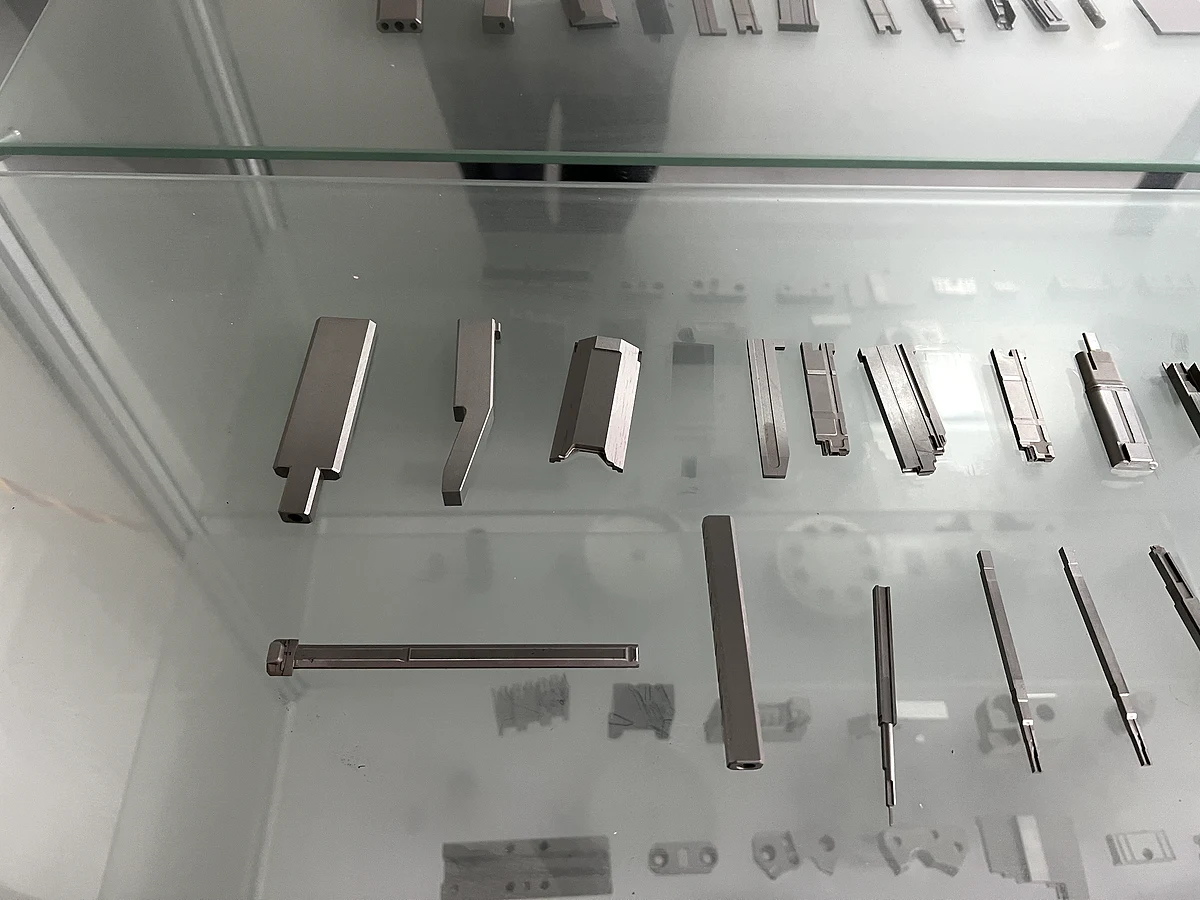
These photographs show representative stamping die components from Huicheng’s factory. Customer names, drawing numbers and dimensional values are not shown.
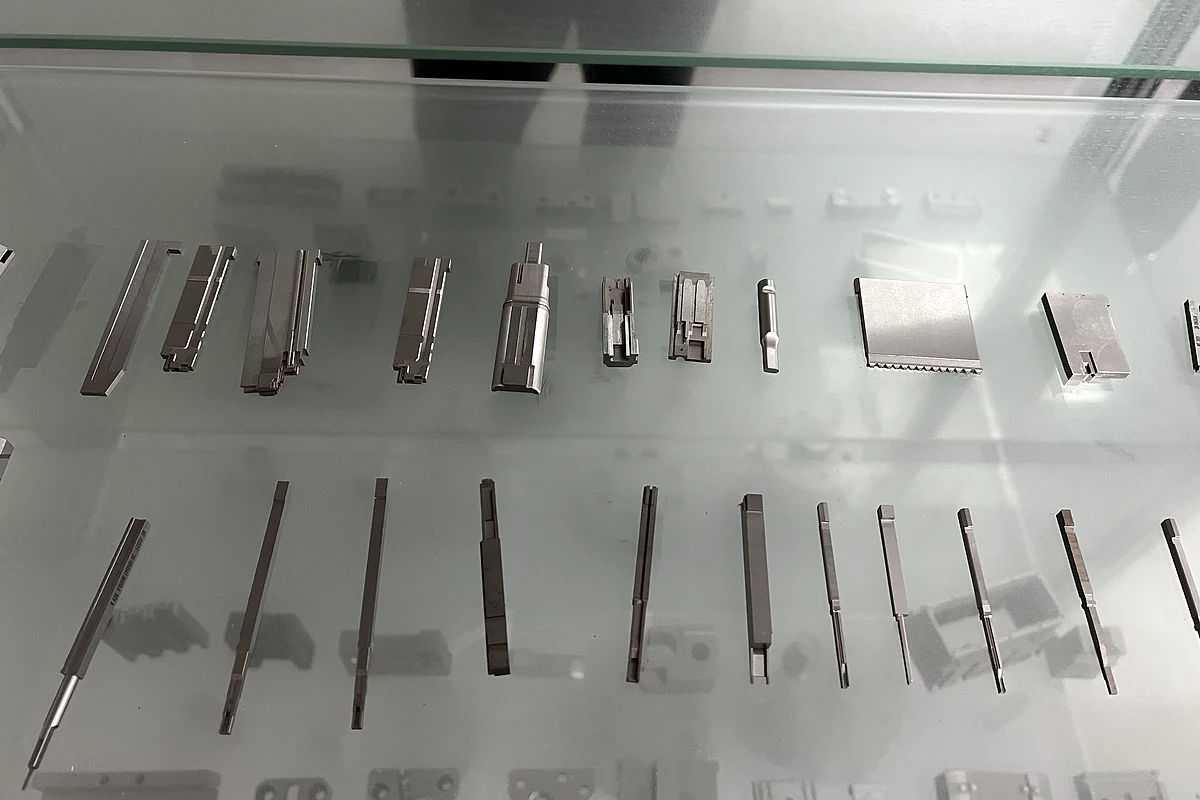
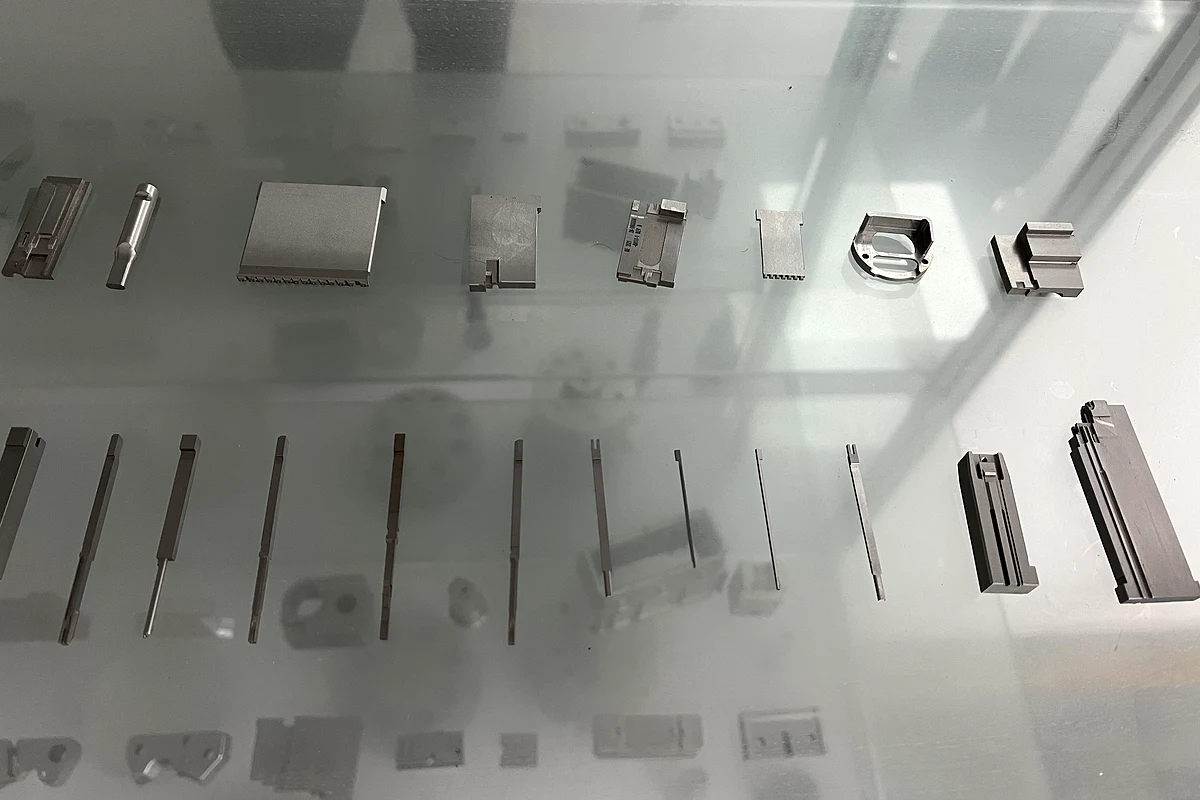
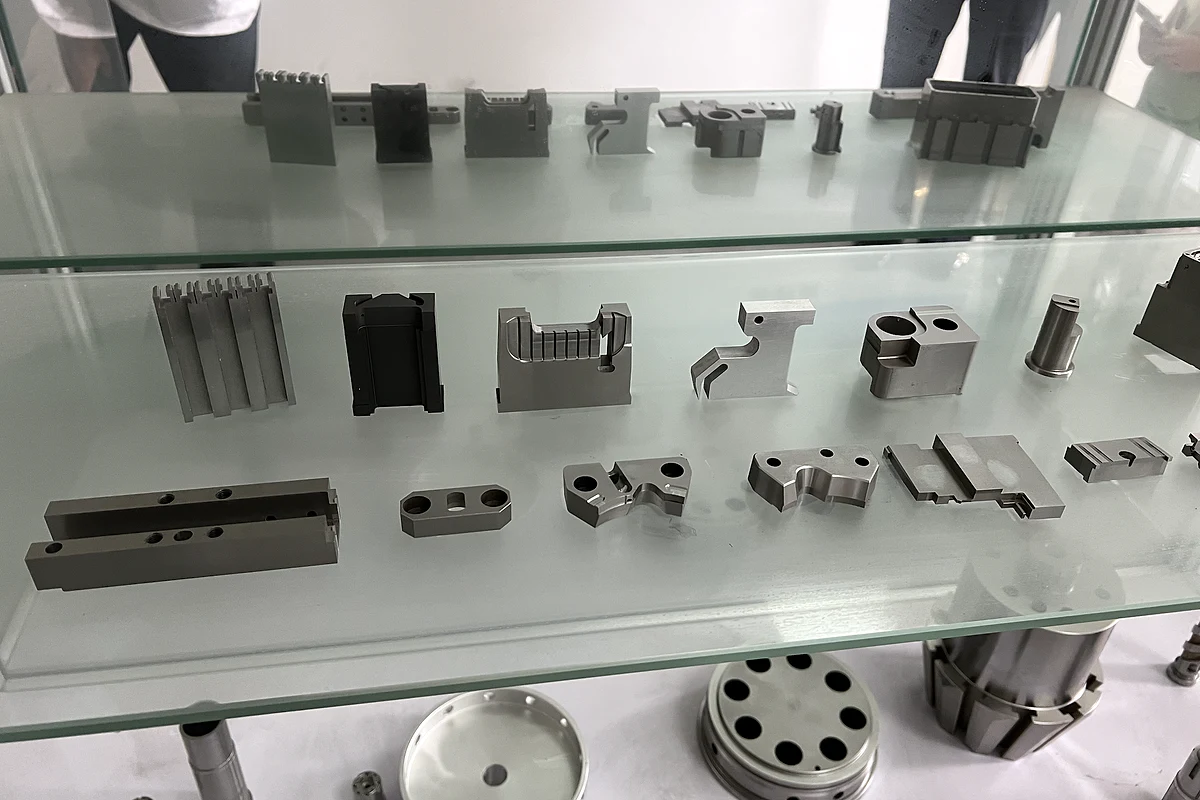
Representative work only. Customer drawings, names, dimensions and project identifiers are not shown.
Control profile, hardness
and punch-to-die clearance.
Stamping die components must balance profile accuracy, edge sharpness, hardness for wear resistance and perpendicularity for aligned shear. The route must coordinate heat treatment, grinding and clearance verification.
Drawing review and clearance planning
Confirm punch and die profile, material thickness, clearance specification (percentage of material thickness or absolute dimension), perpendicularity requirement, hardness, quantity and delivery date. For progressive dies, review station sequence and pilot hole location.
Material selection
Select steel by wear resistance, toughness and heat treatment stability. Standard materials include DC53, SKD11, ASP23 (powder metallurgy HSS), Cr12MoV and tungsten carbide for ultra-high-cycle or abrasive applications. Material must support HRC 58–62 for most stamping applications.
CNC roughing and wire EDM profiling
Rough external form and mounting features by CNC milling. Wire EDM cuts the final punch and die profile to within grinding stock. For complex progressive dies, wire EDM also cuts internal pockets, pilot holes and stripper openings.
Heat treatment to HRC 58–62
Vacuum heat treatment to specified hardness. Stamping punches and dies typically require HRC 58–62 for wear resistance and edge retention. Post-HT stress relief may be specified to minimize grinding distortion.
Precision grinding
Grind top and bottom faces for flatness and parallelism. Grind punch and die profiles when wire EDM surface finish or edge sharpness is insufficient. For matched punch/die sets, coordinate grinding to achieve target clearance (typically 3–10% of material thickness depending on material and edge quality requirement).
Guide post and bushing fitting
Install and fit guide posts and bushings to control punch-to-die alignment. Verify perpendicularity, clearance and smooth sliding motion. Lapping or honing may be required for tight-clearance guide systems.
Final inspection and trial stamping
Measure profile, flatness, perpendicularity and hardness. For matched punch/die sets, verify clearance with gauges or trial stamping. Inspect stamped part edge quality, burr height and dimensional accuracy.
High hardness, high wear
and edge retention.
Stamping die materials must support HRC 58–62 hardness for wear resistance and edge retention, while maintaining toughness to resist chipping and cracking under repeated impact. Material selection depends on stamped material, cycle life and edge quality requirement.
General-purpose stamping steel
Excellent toughness and wear resistance at HRC 58–62. Lower distortion after heat treatment compared to SKD11. Standard choice for blanking, piercing and forming dies in most metal stamping applications. Good edge retention and chipping resistance.
High wear, lower cost
Traditional stamping die steel with high wear resistance at HRC 58–62. More prone to heat-treatment distortion than DC53 but lower material cost. Suitable for moderate-cycle stamping where grinding stock can compensate for distortion.
Ultra-high wear, long life
Powder metallurgy high-speed steel with superior wear resistance and toughness at HRC 62–64. Used for ultra-high-cycle stamping, abrasive materials (stainless steel, spring steel, high-carbon steel) or critical applications where die life and edge quality are paramount. Higher material cost.
Extreme wear, brittle
Hardness HRC 70+ with extreme wear resistance. Used for stamping punches in ultra-high-cycle production (millions of hits) or abrasive materials. Brittle; requires careful handling and impact consideration. Typically used as inserts, not full die blocks.
High-speed steel for forming
High-speed steel with good toughness and wear resistance at HRC 60–63. Used for forming punches, bending dies and applications where impact toughness outweighs maximum hardness. Not as wear-resistant as powder metallurgy grades but lower cost.
What buyers usually
need to confirm.
What files are needed to quote stamping die components?
Provide controlled 2D drawings with profile, clearance specification (or material thickness for clearance calculation), perpendicularity requirement, material, hardness, surface finish, quantity and delivery date. For progressive dies, provide station layout, pilot hole location and strip layout. For matched punch/die sets, state whether they are quoted together or separately.
Can Huicheng manufacture punch and die as a matched clearance set?
Yes. Matched punches and dies can be manufactured to coordinated clearance specification (e.g., 5% of material thickness, or absolute clearance dimension). Provide material thickness, edge quality requirement and whether clearance must be verified by trial stamping or gauge measurement.
What is the tightest profile tolerance Huicheng can hold on stamping dies?
Wire EDM and grinding records show stable profile tolerance of 0.01 mm for stamping punches and dies. Tighter capability (0.005 mm) may be achievable depending on profile complexity, corner radii and material; confirm at RFQ.
Can Huicheng provide trial stamping and edge quality inspection?
Stamping trial capability is limited compared to injection molding trial. Huicheng can coordinate trial stamping with external press facilities when specified. Edge quality, burr height and dimensional accuracy can be measured and documented before shipment.
What hardness range can Huicheng achieve for stamping dies?
Vacuum heat treatment records show stable hardness of HRC 58–62 for DC53, SKD11 and high-speed steels. Higher hardness (HRC 62–64) is achievable with powder metallurgy grades (ASP23, ASP60). Confirm target hardness, uniformity requirement and measurement method at RFQ.
Can stamping dies be supplied with coating or surface treatment?
Yes. PVD coating (TiN, TiAlN, CrN), nitriding, DLC coating and chrome plating can be coordinated as external processes. State the required coating type, thickness and whether coating must be applied before or after final grinding.
Ready to quote stamping die components?
Send the drawing, material thickness, clearance specification, hardness, quantity and target delivery date.