The lowest unit price becomes useful only when you know what it buys. Two suppliers can quote the same mold insert drawing and still offer different finishing stages, inspection deliverables, fitting responsibilities and delivery milestones. A price comparison that misses those differences can award the order before the actual cost is understood.
This guide is for tooling buyers, project managers and engineers comparing quotations for custom inserts, matched sets or replacement parts. It also covers a common starting point: you need an insert but do not yet have a complete drawing package. Huicheng can manufacture to customer-supplied drawings and help customers prepare drawings. When drawing assistance is needed, include that work in the comparison instead of treating every offer as machining-only.
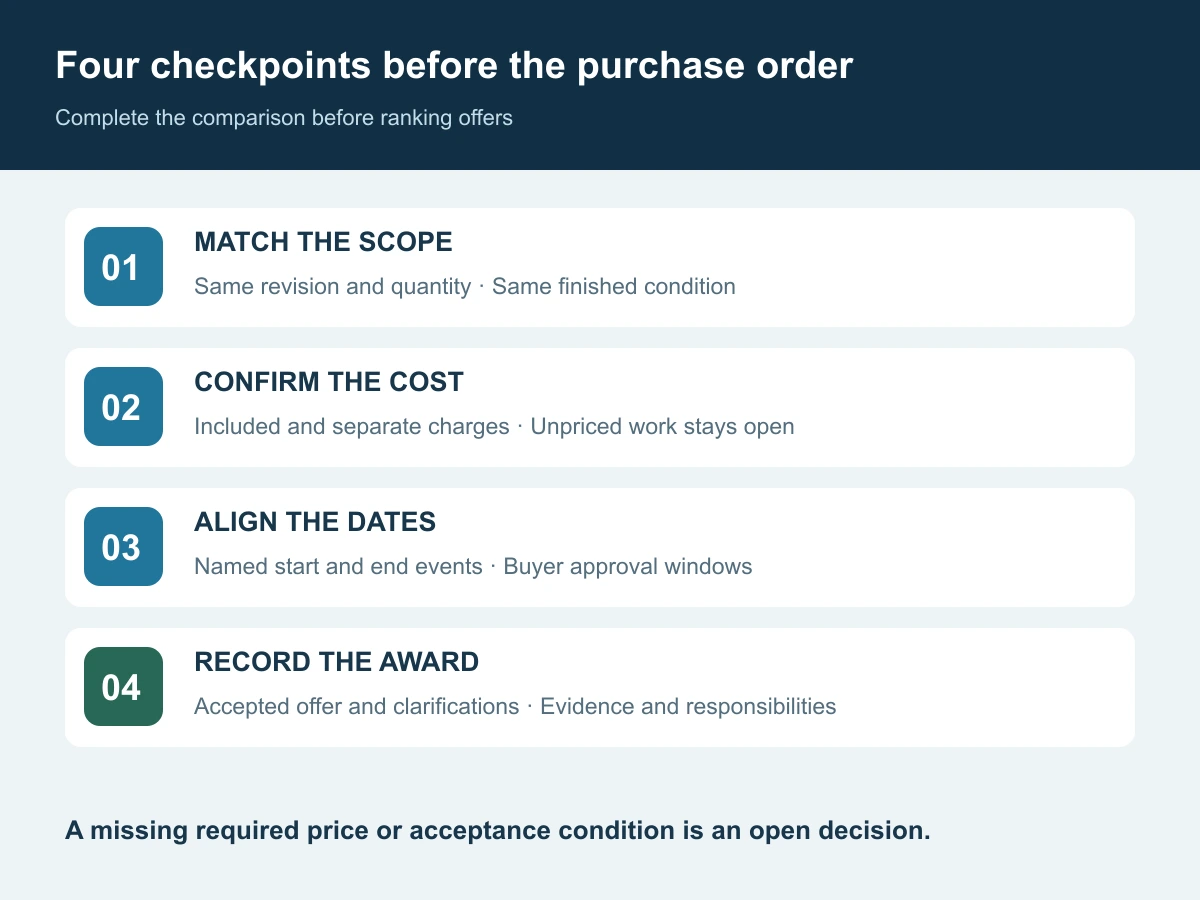
Compare precision mold insert quotes against one approved delivery requirement: the same revision, quantity, material condition, finished interfaces and acceptance evidence. Add confirmed charges for missing required work, put every delivery promise on the same timeline, and leave unresolved items visibly open. Then rank the offers that meet the technical and scheduling requirements.
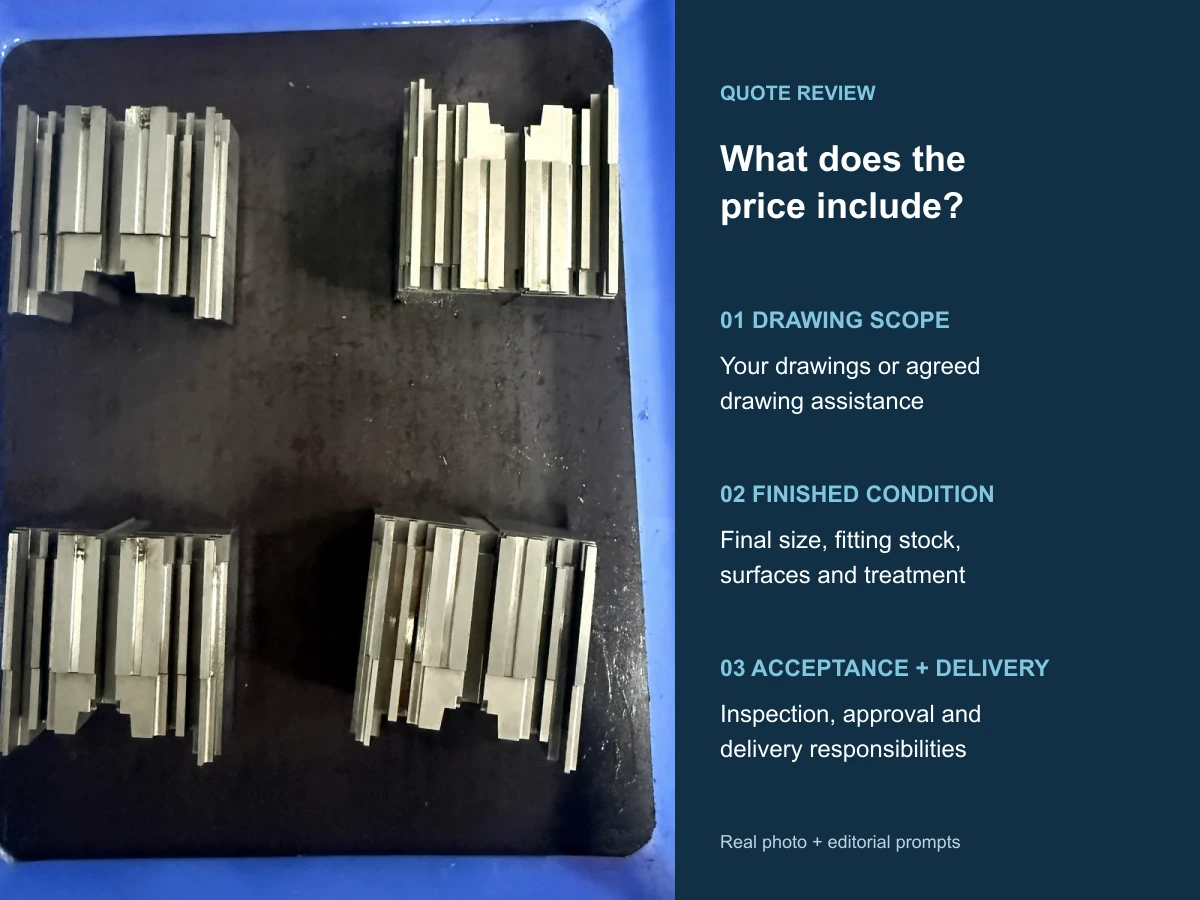
Define what an acceptable delivery includes
Begin with a one-sentence delivery definition. For example: “Supply four individually identified inserts to drawing revision C, in the approved material and final hardness, with the specified surfaces finished and the agreed dimensional report supplied before dispatch.” Add assembly or trial acceptance only where the purchase actually includes it.
That sentence gives the comparison a consistent endpoint. “Machined insert,” “finished insert” and “ready to fit” can mean different things. An insert delivered with approved fitting stock may be entirely correct for one project but incomplete for another that requires final-size parts.
Also distinguish a matched set from interchangeable spares. A supplier may fit four numbered components to four assigned pockets without promising that any component will fit every pocket. If interchangeability is required, the mating-interface information and verification scope must support it.
Do not turn supplier assumptions into requirements after the quotation. Record the agreed baseline, send it to every bidder, and ask each supplier to identify exceptions against that same version. If a requirement changes, obtain revised offers before comparing them again.
Three insert-buying situations that change the scope
- Several inserts for one mold: identify each part and its assigned pocket. Compare the same set, marking requirements and fitting responsibilities—not merely the same total piece count.
- A spare for an existing mold: state whether acceptance is against the approved drawing, the current mating interface or both. If the pocket has been modified or worn, resolve the difference before assuming a drawing-identical spare will fit.
- An insert delivered for final fitting: identify exactly where stock must remain and who removes it. Compare that offer separately from a final-size insert; otherwise the buyer may mistake transferred finishing work for a saving.
Compare drawing assistance as well as machining
You do not need a complete production drawing to start a discussion with Huicheng. We can work from your supplied drawings or help prepare drawings for the required mold insert. Share the information you already have: existing drawings or models, sketches, photographs, available sample information, the insert’s function and its mating relationships. We can then discuss what needs to be clarified and agree the drawing work required.
The first review turns the available information into a list of confirmed requirements and open questions. A photograph can help explain the part, while hidden geometry, the intended fit and material condition need supporting information. Work through dimensions, interfaces, datum references, material, hardness, finish and acceptance requirements together. Confirm any proposed change to a functional feature before releasing the drawing.
Compare two separate scopes: preparing an agreed drawing and manufacturing to the approved revision. Agree what drawing or model files will be delivered, which inputs each party provides, how review and revisions will be handled, and whether drawing work is included or separately charged. This lets you compare a drawing-and-manufacturing offer fairly with a machining-only offer, while keeping the project scope clear.
Use a clear release sequence: review the available information, agree the drawing scope, prepare and review the drawing, obtain customer approval, and confirm the manufacturing quotation and schedule against that revision. If the initial price is only a budget estimate, label it accordingly. Drawing preparation and customer review time should not be hidden inside a machining lead-time promise.
Build a quotation comparison matrix
Use four response labels: included, separately priced, excluded, and clarification required. A blank cell means clarification required. An excluded operation may be acceptable when another named party will perform it and its price, timing and responsibility are confirmed.
| Comparison line | What must match | Evidence to request |
|---|---|---|
| Part and quantity | Drawing/model revision, quantities per part number, handed versions and spare sets | A line-item offer referencing the exact package |
| Drawing assistance, if needed | Required drawing/model deliverables, available inputs, review rounds and approval responsibility | Agreed drawing scope, included or separate charges, and the revision required for manufacturing release |
| Material condition | Approved grade, substitution policy, final condition and traceability scope | Explicit acceptance or a named exception |
| Manufacturing endpoint | Required final sizes, fitting stock, edges and functional surfaces | A marked-up drawing identifying unfinished or excluded zones |
| Finishing and treatment | Grinding, polishing, texturing or coating where specified | Included operations and dimensions that apply after finishing |
| Inspection | Characteristics, quantity inspected, alignment and report deliverables | A sample report format or inspection-scope statement |
| Assembly or trial | Component-only delivery versus fitting or trial support | Location, supplied mating parts and the agreed completion point |
| Commercial charges | Currency, quantity basis, one-time charges, packing and delivery destination | Itemized inclusions, exclusions and quotation validity |
| Delivery | Start event, review windows, dispatch and required arrival date | Dated milestones with buyer and supplier responsibilities |
Link each comparison cell to the supplier’s quotation line or written clarification. This prevents a conversation with one salesperson from becoming an undocumented assumption in the purchasing record.
Understand why machining prices differ
Ask suppliers to explain the two or three features that dominate their offer. The goal is to identify a different interpretation or a feasible design improvement; access to the supplier’s complete internal costing is usually unnecessary.
Geometry, access and setup
Programming and setup can be significant on a small batch. Deep features, restricted access and operations on several faces can change the route. Protolabs Network’s CNC cost-reduction guidance identifies geometry, tolerances and setup count as cost drivers. Its general design recommendations are starting points for discussion, not default acceptance limits for precision mold inserts.
Tool reach deserves a specific question. Sandvik Coromant describes how long-overhang milling changes vibration considerations in its long-overhang machining guidance. When a supplier flags a deep recess, ask which feature requires a different tool, setup or process. An approved change to access or corner geometry may help; a functional forming surface cannot simply be altered to obtain a lower quote.
Heat treatment and final geometry
A quotation covering rough machining before hardening is not comparable with one covering delivery at final dimensions afterward. Uddeholm’s heat-treatment guide explains dimensional changes during hardening and tempering and the role of subsequent correction. The purchasing question is which supplier owns the required final result, including finishing after the specified treatment.
Ask whether external treatment, transport between operations and final remeasurement are included. A lower price can be valid when those operations are legitimately outside the order. They still belong in the buyer’s comparison if the project needs them.
Tolerance and inspection interpretation
Two offers may use the same tolerance values but different assumptions about the datum system, feature coverage or inspection quantity. ASME’s Y14 standards overview identifies the role of dimensioning and tolerancing in communicating design requirements. Confirm the standard and edition called out by the drawing, then agree how the relevant requirements will be demonstrated.
“CMM report included” does not identify which parts or characteristics will appear in the report. Request a deliverables list. A cheaper limited report may satisfy the order; an extensive report may still omit the required fit evidence. Assess coverage against the accepted delivery definition.
Compare two quotes using a worked example
Illustrative arithmetic only: the following figures are invented to demonstrate the method. They are not Huicheng quotations, supplier performance data or market-price benchmarks.
Assume the buyer needs four inserts, one agreed inspection package and delivery to the same destination. Both suppliers have confirmed the same technical scope except for the separately listed charges below. All figures are dimensionless illustrative cost units, not a currency or a guide to real prices. Drawing preparation is outside this example: both offers use the same customer-approved drawing. Taxes, duties and buyer-side costs are assumed equal or not applicable solely to keep this example focused; an actual comparison must record them where relevant.
| Cost line | Quote A | Quote B |
|---|---|---|
| Quoted unit price | 420 | 475 |
| Four inserts | 1,680 | 1,900 |
| One-time preparation charge | 160 | Included |
| Required inspection package | 120 | Included |
| Same-scope packing and delivery | 100 | 100 |
| Comparable confirmed total | 2,060 | 2,000 |
| Comparison cost per insert | 515 | 500 |
Quote A starts 55 cost units lower per insert, or 220 lower for the batch. Once the confirmed required charges are added, its total is 60 cost units higher. Dividing by four creates a comparison figure; it does not change the supplier’s contractual unit price.
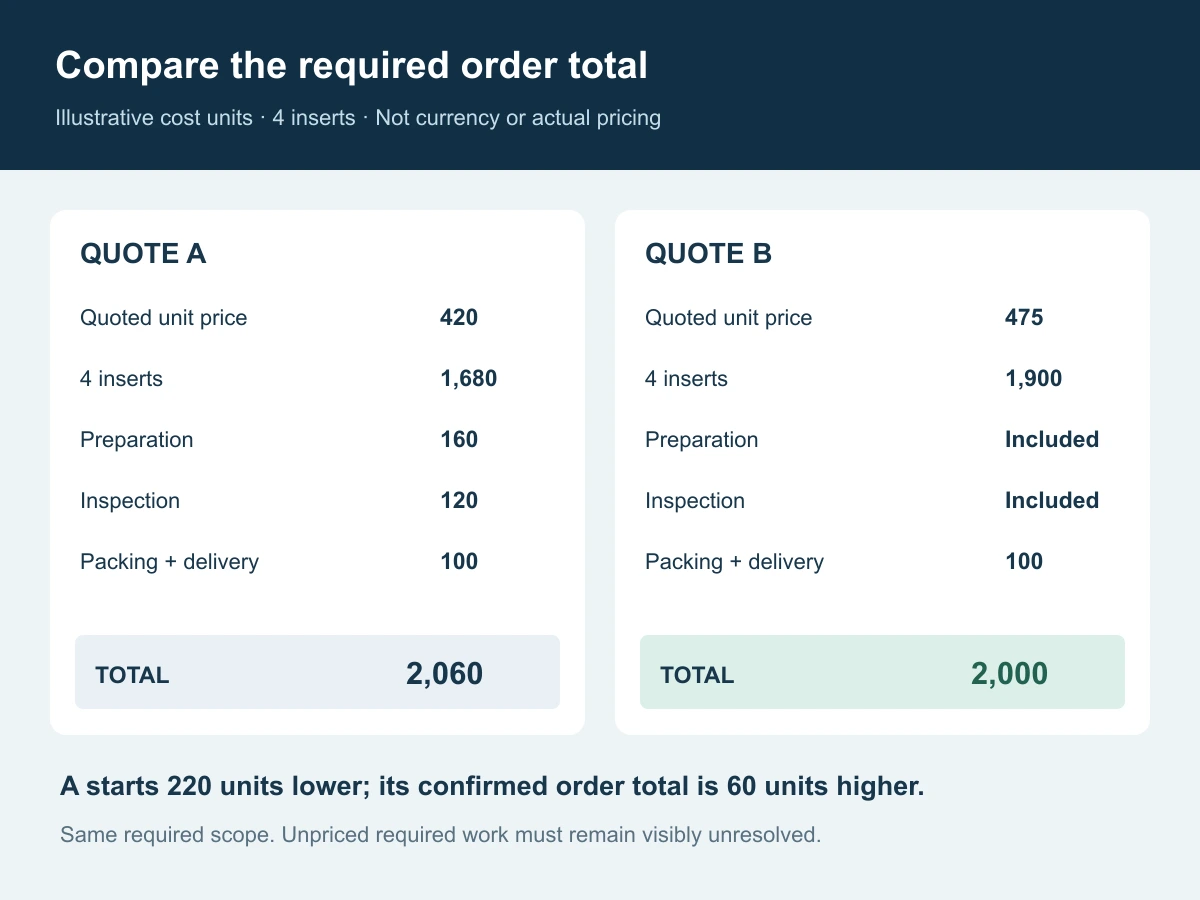
The method is simple: comparable confirmed total = quoted batch amount + confirmed charges for required work outside that amount. Count each item once. If a price includes inspection, do not add the same report again under quality costs.
Keep unknowns out of a supposedly exact total. If Quote A excludes polishing and no price has been confirmed, label it “2,060 cost units plus unpriced required polishing.” It is not ready for a final cost ranking. Seek a revised offer or a separate confirmed price before award.
Do the same with risk. An internal delay scenario can help management assess exposure, but it should remain separate from the confirmed order value. Do not invent a rejection probability or add a generic “quality penalty” simply because one supplier is unfamiliar.
Compare dates and approval milestones
“15 working days” and “20 working days” cannot be ranked until they share a start event and endpoint. One may begin after drawing approval and end at dispatch; another may include a customer review period. Obtain actual planned dates against your required arrival date.
Ask each supplier to identify material readiness, completion of critical external operations, inspection-report submission, the buyer’s review window and dispatch. Confirm which activities can overlap. Do not mechanically add every duration if the supplier schedules some work in parallel.
An “inspection complete” milestone also needs a definition. Does it mean the supplier has measured the inserts, issued the report, or received buyer release? If shipment waits for approval, assign an owner and response date. The buyer’s silence should not be the hidden assumption behind a delivery promise.
Separate first-order and repeat-order costs
A first order can include programming, fixture preparation, electrode preparation or first-article documentation. Ask which charges are one-time, which recur, and what conditions trigger them again. A revision may require new work even when the part number remains the same.
For forecast demand, request separate prices for the initial order and a repeat batch at a stated quantity. Clarify whether the supplier must keep any fixtures, electrodes or inspection programs available, for how long, and on what commercial basis. Payment for preparation does not automatically answer ownership, storage or transfer questions.
Volume savings also depend on the ordering pattern. A single batch of twenty parts and five separately released batches of four may have different setup and inspection costs. Compare the release schedule you expect to use. Avoid ordering speculative stock solely to obtain a lower unit price when design revisions are still likely.
Decide what to clarify before awarding
Use technical conformity and the required delivery date as entry conditions for ranking. If an offer cannot yet confirm a critical interface or the finished material condition, place it on hold for clarification. A low price does not resolve that missing information.
For offers that pass, compare confirmed cost, the credibility of the proposed milestones, responsiveness to technical questions and the quality of the promised evidence. Where experience is limited, a defined first order can establish evidence before a larger commitment. It should have clear acceptance criteria and a realistic purpose.
Common hold points include an unnamed material substitution, “standard tolerance” replacing drawing requirements, unpriced required finishing, an inspection promise without coverage, and a lead time with no start event. These are questions to close, not automatic proof of poor supplier quality.
Record the award reason in one paragraph. For example: “Selected B because both offers meet revision C and the required arrival date, while B’s confirmed four-piece total is 60 cost units lower after required charges. Final inspection coverage and shipment release responsibilities are documented in clarification 02.” This makes the decision understandable after the original buyer moves to another project.
Send a focused clarification request
Before negotiating a discount, ask for an offer that can be accepted without guessing. The following message can be adapted to the actual gaps:
Please revise quotation [reference] against drawing package [revision] for [quantity by part number]. Confirm the final manufacturing condition and identify any excluded finish, treatment, fitting or inspection work. Separate one-time charges from recurring charges and confirm the packing and delivery scope to [destination]. List the inspection deliverables and the event that starts the lead time, together with planned report and dispatch dates. Please return a single revised quotation incorporating the agreed clarifications and its validity period.
Discuss your insert project with Huicheng—with or without a completed drawing. For custom precision mold inserts, send your existing drawings and models if available. If you need help preparing drawings, share your current sketches, photographs or sample information and explain the intended function and mating parts. Include quantities, any known material and finish requirements, and the required arrival date.
Ask us to review the drawing support needed, questions affecting manufacturability, final delivery condition and inspection scope. Agree any drawing charges and review milestones alongside the manufacturing quotation. You can then move forward with a customer-approved drawing, a defined manufacturing scope and clear acceptance requirements.
Frequently asked questions
Why do mold insert quotes vary for the same drawing?
Suppliers may have different process routes, capacity, setup needs or purchasing costs. They may also interpret scope differently. Start by checking revision, final condition, inspection coverage, quantity and delivery assumptions before attributing the difference to efficiency or quality.
Should I always choose the higher-priced supplier?
No. Price alone is not evidence of capability. After aligning scope, compare confirmed cost, acceptance evidence and schedule confidence. A lower offer may be the best choice when its deliverables and responsibilities are clear.
Is a per-piece price enough for a purchase decision?
Only when required preparation, finishing, inspection and delivery charges are already included or separately known. For small quantities, fixed charges can materially change the batch comparison.
Can Huicheng help if I do not have a complete drawing?
Yes. Huicheng offers manufacturing to customer-supplied drawings and can help customers prepare drawings for mold inserts. Start with the information you have. The required drawing work, deliverables, charges and review process should be agreed for the project, with customer approval of the manufacturing drawing before machining begins.
Can I estimate the price from a photograph?
A photograph can support an initial discussion but does not establish hidden geometry, material condition, tolerances or acceptance requirements. Treat a photo-based estimate as preliminary until the supplier has reviewed the controlling part information.
What is the best way to ask for a lower price?
Ask which approved changes to batch size, delivery flexibility or nonfunctional features would reduce cost. Keep each alternative separate from the fully compliant base offer so the saving and engineering consequence can be reviewed together.
Sources and scope: Four primary-source links support the engineering context. The comparison matrix, quotation arithmetic and award workflow are original editorial tools. All numerical cost examples use illustrative units rather than currency; this article makes no claim about Huicheng pricing, lead-time guarantees or a particular supplier’s performance.