A precision mold insert can pass final inspection and still arrive unfit for installation. A small dent on a locating face, corrosion on a forming surface or a missing pocket identifier can delay a tooling project even when the outer carton looks acceptable.
For buyers, precision mold insert packaging should be part of the delivery requirement. “Export packing” describes too little: it does not identify how the part is restrained, which surfaces may touch the packaging, how corrosion protection works, or what the receiver must do after opening it.
Specify three separate protections: mechanical restraint that keeps inserts apart and supports suitable surfaces; a compatible corrosion-protection system for the planned route and storage period; and identification that connects each part to its drawing and inspection record. Ask for packing evidence before dispatch and instructions for receiving, cleaning and resealing unused spares. A strong box or a VCI bag alone does not address all three needs.
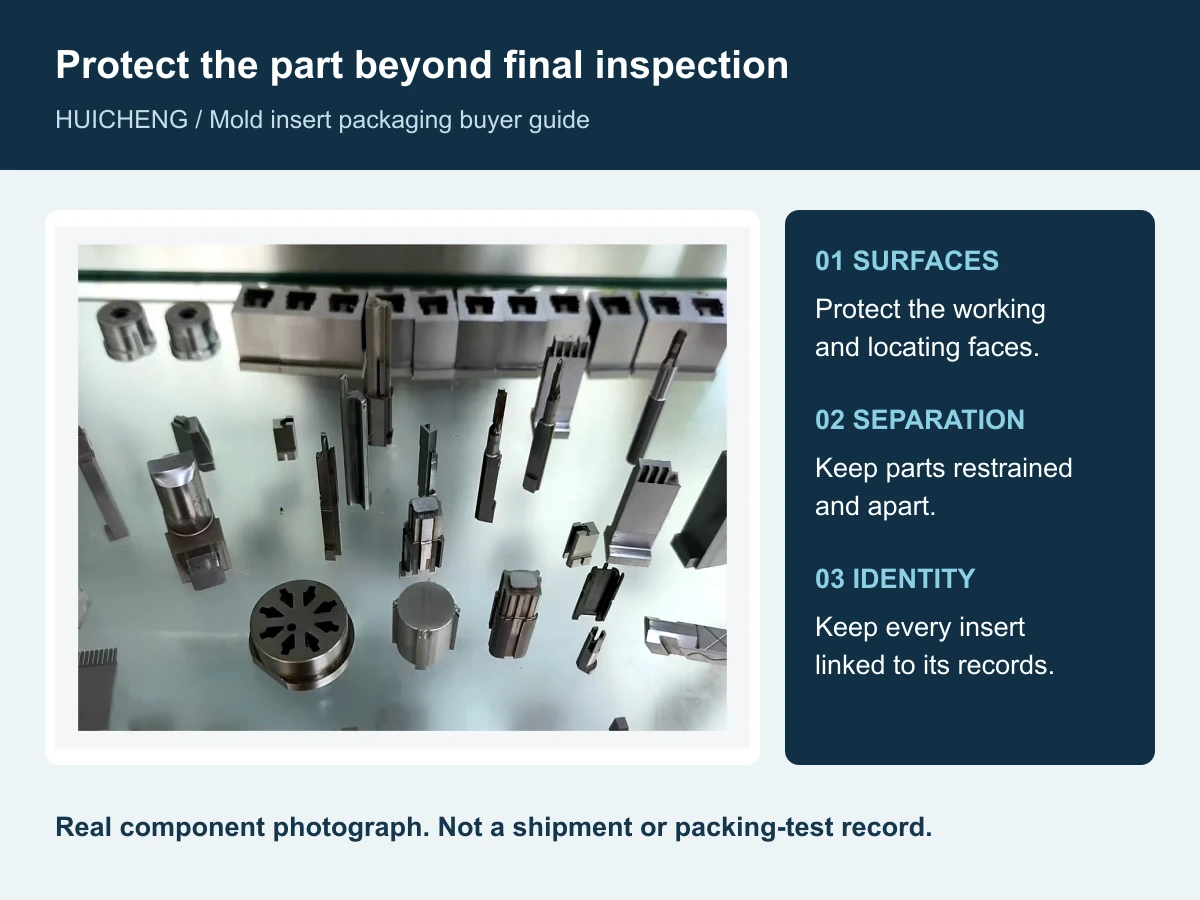
Identify the damage that would stop installation
Start with the component’s function. A scratch on an approved nonfunctional support area is different from a raised dent on a datum face. Ask the tooling engineer to identify surfaces that must remain free from contact damage, residue or deformation. The packing designer can then choose support and separation around those requirements.
| Vulnerable area | Possible consequence | Requirement to define |
|---|---|---|
| Locating and seating faces | A dent, burr or trapped particle prevents the intended seating | Clean contact materials and approved support locations |
| Thin ribs, tips and shut-off edges | A concentrated load chips or bends a functional feature | Clearance around delicate geometry and restraint elsewhere |
| Polished, textured or coated surfaces | Rubbing, debris or incompatible residue changes the delivered condition | Compatible surface protection and a removal method |
| Unprotected steel and recessed features | Moisture or contamination causes staining or corrosion | Clean, dry preparation and a specified preservation system |
| Similar-looking matched parts | Parts reach the correct factory but the wrong pockets | Individual or set identification that survives unpacking |
Protect the steel geometry rather than altering it for easier packing. An edge that is sharp by design needs a suitable guard or clearance; the packer should not add an unapproved chamfer. Similarly, do not use a convenient hole as a fastening point unless its use and the associated loading have been approved.
Restrain the insert without loading delicate features
Separate metal parts so that they cannot strike or rub against one another. Then restrain each part within its compartment. Individual wrapping can reduce surface contact, but it does not necessarily stop a dense component from moving through loose filler.
UPS’s guidance for heavy packages emphasizes suitable outer-box strength and dense cushioning, and warns that loose fillers can crush or shift under heavy loads.[1] The relevant design question for an insert set is whether its support and cushioning remain effective under the actual load. Carrier-specific weight limits and packing rules must be checked for the selected service.
Locate support on sufficiently robust, approved areas. Keep a clearance zone around slender projections and delicate working edges. Restraint should not require squeezing a thin wall, tightening a strap across a polished face or allowing a screw head to touch a forming surface.
Review movement in every relevant direction, not only with the box upright on a bench. The lid, separators and retaining features must work together. A deep foam cavity with an unsupported tip at its bottom can transfer impact directly to the feature it appears to protect.
Specify the contact material as well as its shape. Check its cleanliness, abrasion risk, compressive behavior and compatibility with the selected preservative and surface finish. Material color or softness to the touch does not establish suitability. Loose screws, plugs or accessories should have their own identified compartment.
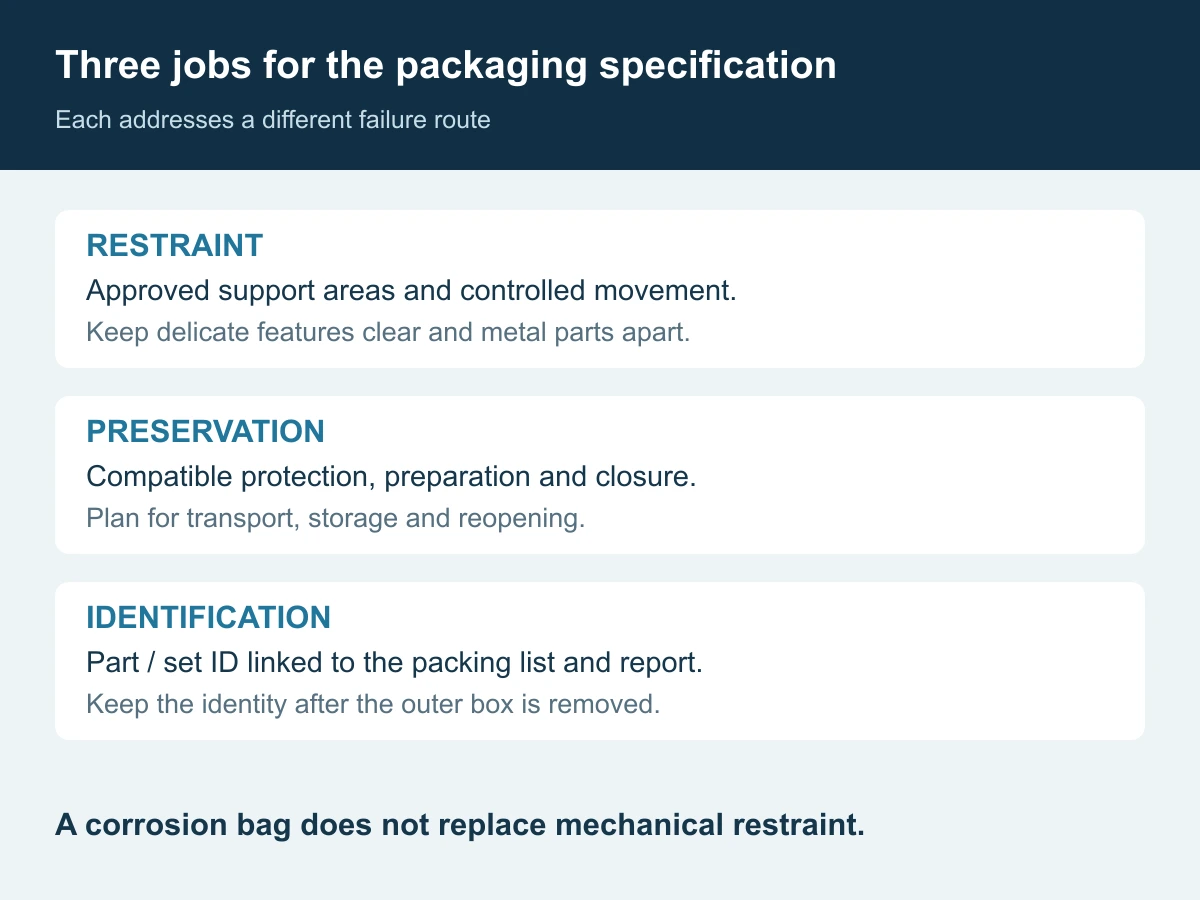
Choose corrosion protection as a system
Agree preparation before selecting a bag or preservative. Remove machining debris and relevant residues using a method compatible with the part. Check recesses and holes where liquid can remain, and avoid recontaminating prepared surfaces during handling.
ZERUST advises that parts be clean, cool and visibly dry before sealing in its VCI packaging; vapor corrosion inhibitors do not remove standing water.[2] For the buyer, “VCI bag included” should therefore trigger questions about preparation and closure, not end the corrosion review.
The following options have different jobs. The final combination should follow the protection-material supplier’s instructions and the project’s cleanliness requirements.
| Option | Question to resolve | Limitation to keep visible |
|---|---|---|
| Rust-preventive oil or film | Is it compatible with the material, coating, surface texture and intended cleaning process? | The receiver may need a defined removal step before inspection or use |
| VCI film, paper or emitter | Is the selected product suitable for the metals, enclosed space, closure and intended storage? | It does not replace part drying, physical restraint or edge protection |
| Moisture-barrier enclosure | What barrier performance, sealing method and puncture protection are required? | Trapped initial moisture and a damaged closure can undermine the plan |
| Desiccant within a designed enclosure | What quantity, placement and replacement criteria suit that enclosure and exposure? | A packet is not a universal remedy for wet parts or an inadequately closed package |
Do not combine products simply because each is described as protective. Confirm compatibility between the preservative, packaging contacts, seals and any later cleaning or molding operation. Keep loose protection media away from surfaces and openings where contamination would create a problem.
Specify who removes the protection, using what instructions, and at which stage. A buyer requiring a clean inspection surface on arrival may prefer a different system from one storing spare steel components until a planned shutdown. Avoid a universal protection-duration promise without defined materials, exposure and storage conditions.
Account for the route, storage and opening conditions
Describe the journey beyond “air” or “sea”: collection, consolidation, possible delays, receiving conditions and the period before installation. Also say whether the package will be opened for inspection and whether the remaining parts will go back into storage.
Temperature changes matter at the destination as well as in transit. Cortec notes that opening a package containing cold metal into warm, humid plant air can cause condensation on the parts.[3] Include an appropriate acclimatization and opening procedure in the packing instructions; do not rely on one fixed waiting time for every part mass and environment.
That procedure should also distinguish an intact package from one that is wet, torn or already compromised. A visibly damaged enclosure needs controlled assessment rather than routine storage under the assumptions used for an intact seal.
For spare sets, consider individual preserved units inside a shared outer package. The receiver can remove the needed part without automatically exposing every spare. Whether that arrangement is appropriate depends on part geometry, quantities, handling frequency and the selected preservation system.
Write a useful packing specification
A short, part-specific instruction is more useful than “standard export packing.” Send the packer the functional-face information and ask for a proposed arrangement that addresses the following:
- Identity: part numbers, revisions, quantities, matched-set or pocket assignments, and identification after removal from the box.
- Mechanical protection: permitted supports, no-contact zones, individual separation, accessory containment and restraint.
- Preservation: approved preparation, product names or specifications, closure method, compatibility and removal instructions.
- Exposure: transport route, expected delays, storage period, receiving environment and opening frequency.
- Evidence: packing photographs, package identifiers and the connection to inspection records.
- Receiving and reuse: opening sequence, inspection responsibilities and how unused parts are protected again.
Agree whether packing design, special materials, returnable containers or testing are included in the quotation. A reusable container can be appropriate for repeated transfers, but only if its condition and replacement parts are controlled. Reusing a crushed support or a torn liner does not reproduce the original packing arrangement.
Example request to adapt: Please propose packaging for [part numbers and quantities] to [destination], allowing for [storage period and opening pattern]. Identify approved support areas and protection for the marked functional surfaces. Confirm the preservation materials, closure and cleaning/resealing instructions. Keep matched components individually identifiable, show the arrangement before closure, and state any separate packing or validation charges.
Verify the package before dispatch
Request a small set of useful photographs: identified parts before packing, contact and separation details, completed internal restraint, the closed preservation enclosure where applicable, and the finished outer package with its identifier. Take intermediate photographs where the final packing layer hides important details.
Photos establish visible packing features and condition at a point in time. They do not demonstrate resistance to drops, vibration or extended moisture exposure. If the part value, geometry or route warrants performance validation, agree a test plan with a packaging specialist and define what counts as unacceptable damage.
ISTA’s design and testing guidance emphasizes matching distribution hazards to product vulnerabilities and using suitable pre-shipment testing to assess package performance.[4] Select the test around the intended package and route rather than adding “ISTA tested” as an unexplained label. This guide does not claim that a Huicheng package has passed a particular test.
Inspect the appropriate features after any agreed trial. An undamaged outer box is not sufficient if an insert moved, a working edge was marked or an internal bag was punctured. Keep the packing specification tied to the version actually evaluated.
Before closure, reconcile the packing list with the identified parts and agreed documents. Put operational instructions where the receiver can access them without unnecessarily opening all preserved units. Keep confidential drawings in the agreed document channel rather than adding them to external shipping labels.
Inspect on receipt and preserve unused spares
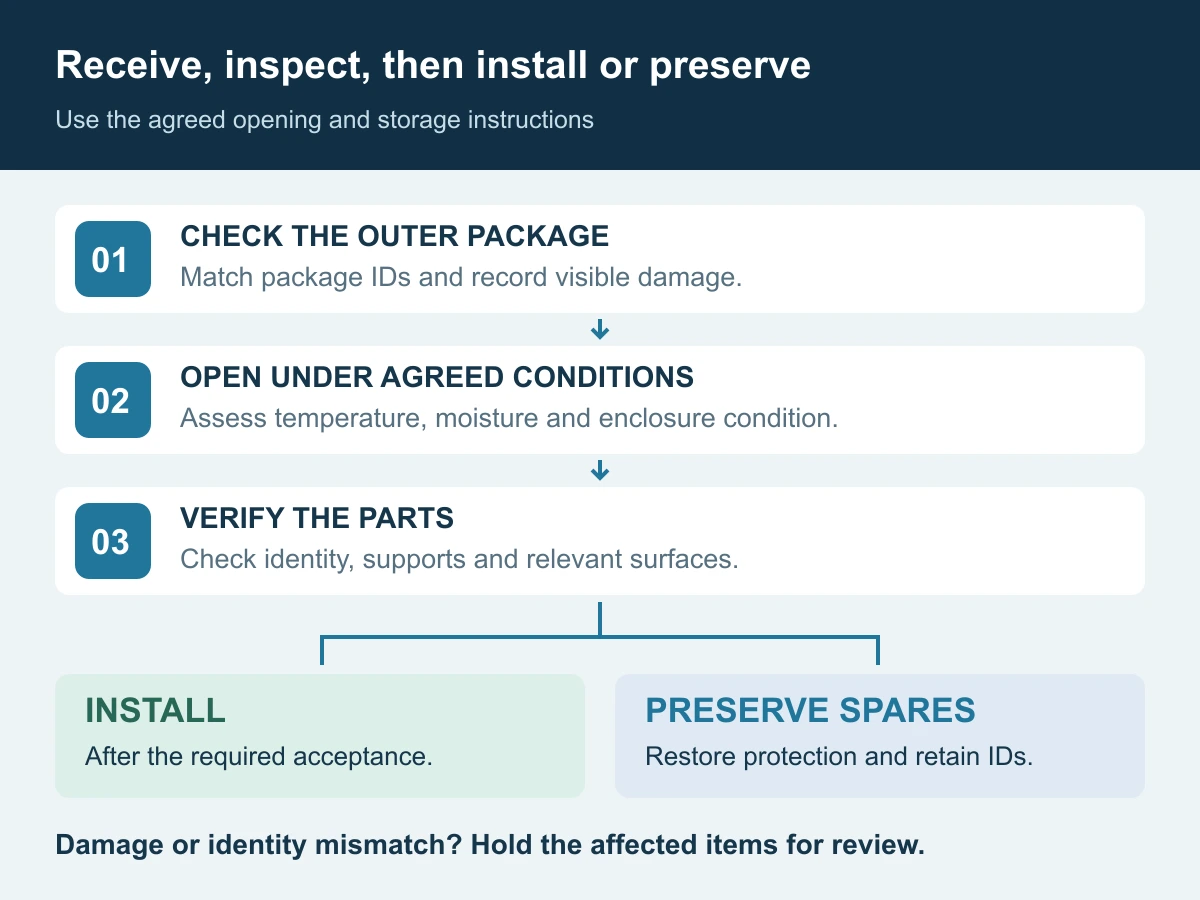
Give receiving staff an opening sequence before the shipment arrives. They should be able to distinguish a visual packaging check from technical acceptance of the insert.
- Record the unopened condition. Match package IDs and photograph visible wetting, crushing, punctures or displaced closures.
- Use the agreed opening environment. Follow the temperature and moisture procedure; route damaged packages for controlled assessment.
- Check identity and internal restraint. Note shifted parts, broken supports, missing separators and exposed edges before rearranging them.
- Examine protected surfaces appropriately. Follow approved cleaning instructions. Escalate suspected corrosion, impact marks or missing identification before fitting or polishing.
- Restore preservation for unused parts. Use the agreed materials and closure, retain identification, and record any new storage-review date required by the plan.
If damage is suspected, preserve the packaging and records while following the agreed reporting process. Avoid removing evidence through unrecorded abrasive cleaning or a quick fitting adjustment. Keep affected items clearly separated until their condition and disposition have been reviewed.
Example: a matched set delivered with spare inserts
Illustrative planning scenario: a buyer orders a matched insert set for immediate installation and separate spares for a later maintenance stop. Everything is shipped in one outer box. Counting the pieces is straightforward, but a common inner enclosure could expose all spares when the first set is unpacked.
The buyer and packer instead agree two identified groups, suitable part-by-part restraint and preservation that allows the working set to be removed while the spare units remain protected. The packing list records any assigned pockets and distinguishes matched components from parts actually specified as interchangeable.
At receipt, the buyer records the installed set, checks the unopened spares and retains the storage instructions. If a spare enclosure is opened later, its protection is restored according to the agreed procedure. The improvement is a controlled opening and storage plan—not a claim that a particular bag guarantees an unlimited shelf life.
Discuss packaging with Huicheng
When requesting custom precision mold inserts, include the delivery destination, quantities for immediate use and spare storage, sensitive surfaces and any restrictions on rust-preventive residues. Ask for the proposed packing method and its scope to be confirmed with the order.
Huicheng can manufacture to supplied drawings and help customers prepare drawings. If that assistance is needed, identify functional surfaces and handling restrictions during the drawing review, then agree the packing requirements for the approved part. Special preservation materials, reusable containers and performance testing should be discussed as project requirements rather than assumed standard inclusions.
Frequently asked questions
Is a VCI bag enough to protect a precision mold insert?
No single bag addresses every risk. The selected corrosion system also needs suitable part preparation and closure, while the packing arrangement must separately control movement, contact damage and identification.
Should every insert be coated with rust-preventive oil?
Not automatically. Agree protection for the actual material, finish, storage conditions and downstream process. Where a preservative is used, specify compatibility and any removal required before inspection or installation.
Does more foam always give better protection?
No. Support location, material behavior, restraint and clearance around delicate features matter. Extra material can still load the wrong surface or allow a dense component to move.
Can unused spares stay in the opened shipping box?
Only if the resulting arrangement satisfies the agreed storage instructions. An opened outer box may still contain intact individually protected units, while opening a shared inner enclosure may require renewed preservation of all remaining parts.
Does a clean-looking package prove that the inserts are acceptable?
No. Check identity, internal condition and the agreed technical requirements. Packaging photographs and receiving observations support the review but do not replace the required component inspection evidence.
Sources and footnotes
Sources checked September 7, 2026. The packing checklist, receiving workflow and matched-set scenario are original editorial guidance; the scenario is not a customer case.
- UPS. How to Ship a Heavy Package. Carrier guidance on outer packaging, cushioning and limitations of loose fillers under heavy loads. Apply the current rules for the selected service. Back to text ↑
- ZERUST/EXCOR. How Dry Should Parts Be Before VCI Packaging? Manufacturer guidance on surface preparation and the limits of VCI protection when free water is present. Back to text ↑
- Cortec Corporation. Are Your Auto Parts Ready for Seasonal Temperature Fluctuations? Manufacturer explanation of condensation risks when cold metal is exposed to warmer, humid surroundings. No specific Cortec product is prescribed here. Back to text ↑
- International Safe Transit Association. Getting Started with Design & Testing. Guidance on relating distribution hazards, product vulnerabilities and pre-shipment package testing. Back to text ↑