A mold insert can be machined accurately and still be the wrong part if the shop is working to a superseded drawing. The risk grows when a buyer sends a revised PDF after quotation, a different engineer sends a STEP model, and production has already started.
The important question is not simply, “Did the supplier receive the latest file?” It is, “Which approved definition applies to each insert, and what happens to the work already completed?” This guide addresses changes between the RFQ and delivery—not how to build an initial RFQ or approve a first sample.
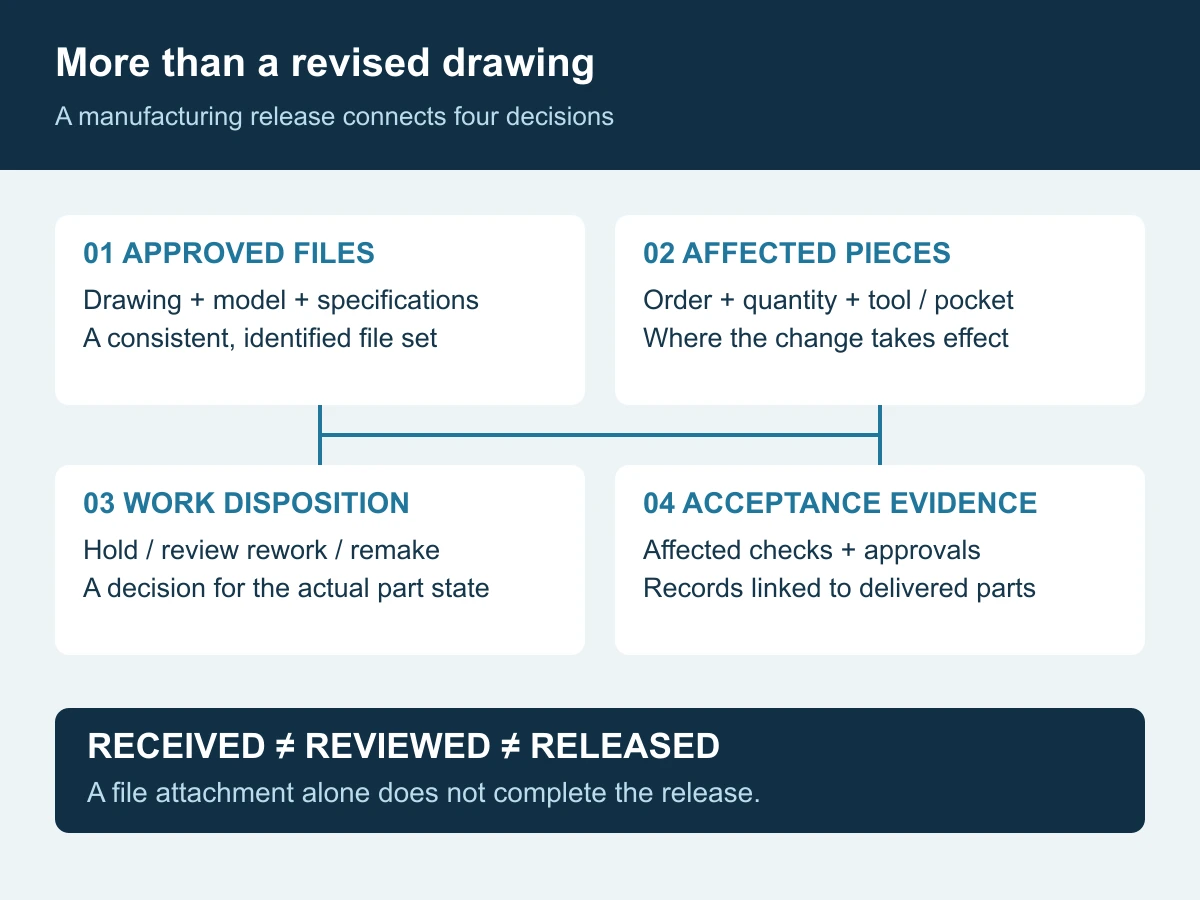
For mold insert drawing revision control, identify the approved drawing and model together, describe the change, specify the affected order and pieces, and obtain an impact review before authorizing changed work. Record how unfinished and finished inserts will be handled, what must be checked again, and when the new revision takes effect. An email attachment is not, by itself, a complete manufacturing release.
1. Control the approved definition, not just the filename
A drawing revision identifies an issued state of a document. A manufacturing release adds permission to perform specified work against an identified set of requirements. Those are related decisions, but they are not interchangeable.
ASME Y14.35 addresses methods for identifying and recording revisions to drawings and associated documents.[1] For a purchased insert, make the practical distinction visible: a file sent “for review” should not be mistaken for an instruction to cut steel.
Do not rely on names such as final.stp, final-new.pdf or latest-approved.zip. Use a part number, a document identifier, an explicit revision and a release record. An unchanged material specification may retain its own revision; the important point is that the release lists the correct combination, not that every related document carries the same letter.
Keep superseded files as history, but clearly separate them from the active manufacturing packet. Deleting the old copy can remove the evidence needed to understand a partially completed batch.
2. If the PDF and STEP model disagree, resolve the conflict before cutting
Neither 2D nor 3D automatically takes priority on every project. Agree what controls geometry, dimensions, tolerances, material, surface finish and inspection requirements. A geometry-only STEP export should not be assumed to contain all the notes or product manufacturing information in its source model. Conversely, an approved model-based definition may carry requirements beyond a conventional PDF.
ASME Y14.41 covers the preparation and revision of digital product-definition data sets.[2] Its public description is useful context; it does not establish a universal document-precedence rule for your purchase order.
For a mold insert, check more than the visible cavity shape: reliefs, locating faces, units and scale must also agree across the released files. If a locating face changes, check whether the datum scheme and related dimensions still describe the intended fit. A geometry change does not automatically require a new datum label; the issue is whether the model, drawing and inspection setup remain consistent. Resolve actual discrepancies before affected machining proceeds.
A useful instruction is: “Use the files listed in release packet RP-03. Resolve any conflict between them before affected work proceeds.” File size, issue date or a checksum can help distinguish attachments, but none demonstrates engineering approval by itself.
3. Put these seven items in the change release
The following is a practical purchasing checklist, not a prescribed standards form. It can be maintained in a controlled PDF, an order record or an agreed document system.
| Item | What to record | Why it matters for inserts |
|---|---|---|
| Part and application | Part number, tool number, cavity/pocket assignment and handedness where relevant. | A correction for one repaired pocket may not suit the other pockets. |
| Approved file set | Drawing/model identifiers and revisions; relevant specifications and units. | A new model with old notes can create a mixed definition. |
| Change description | Old and new requirements, affected features and reason. | A revision cloud alone may not explain the functional consequence. |
| Applicability | PO line, batch, quantity or individual part IDs; effective point. | “Use revision C” does not say whether existing revision B spares remain usable. |
| Work disposition | Hold, proceed unchanged, evaluate rework, remake or another approved outcome. | Rough blanks and finished inserts may need different decisions. |
| Acceptance and commercial impact | Affected checks, required review, revised scope, charges and delivery agreement. | An apparently small change can affect machining access or a booked finishing operation. |
| Authority and acknowledgement | Named approver, release date and supplier acknowledgement of the affected scope. | Receipt of files is different from acceptance of an executable change. |
Define the effective point precisely: for example, “PO line 2, pieces 05–12” or “orders placed after this release.” A calendar date alone may be ambiguous if parts are already moving between machining, heat treatment and finishing.
4. Review what the change touches downstream
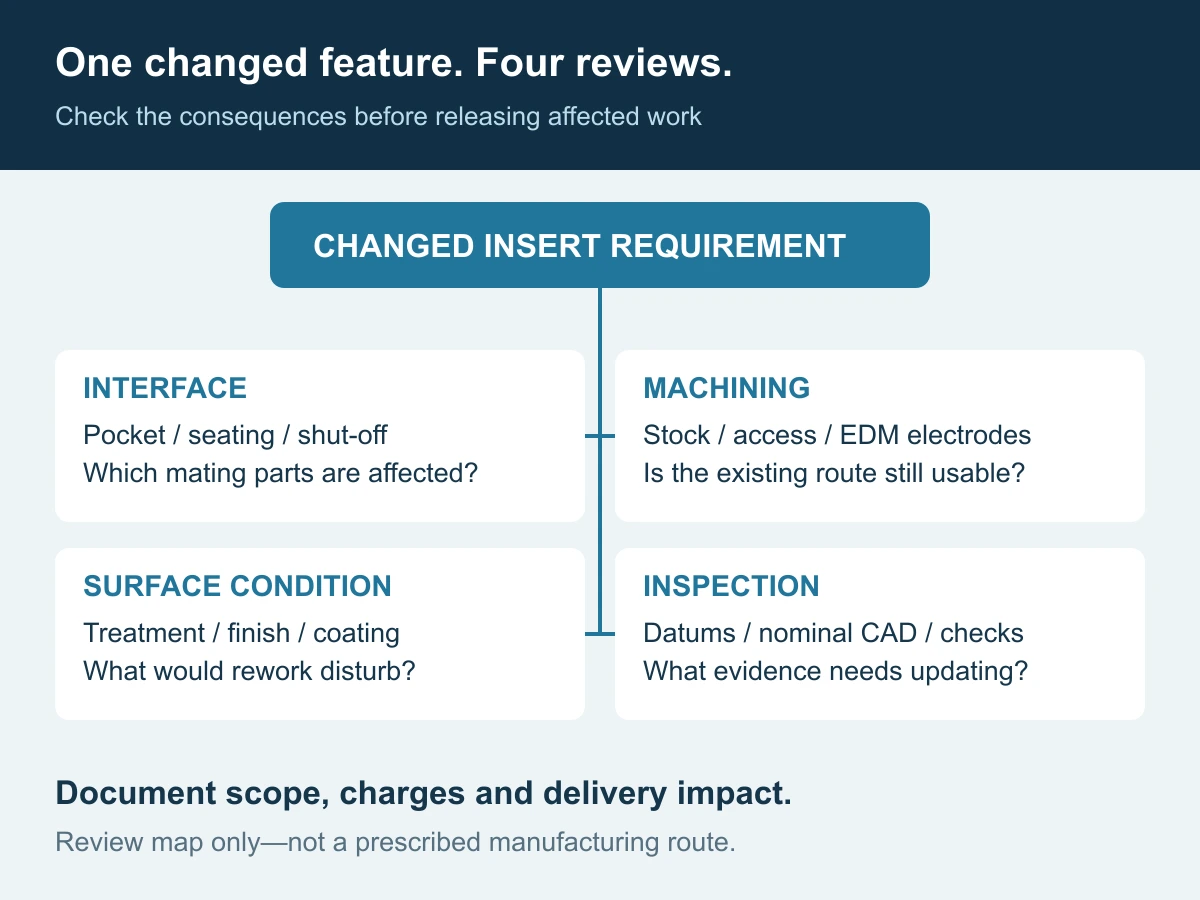
A revision can affect several linked operations even when only one drawing dimension changes. Before accepting a revised delivery date, ask the supplier to assess the actual manufacturing state.
- Locating and seating features: review the mating pocket, available adjustment, seating contact and the consequences for cavity height or shut-off.
- Forming geometry: review cutter access, remaining stock and any affected EDM electrode. Updating the customer model does not establish that a previously prepared electrode is still usable.
- Steel, hardness or treatment: confirm whether already purchased or treated material is still suitable. A note change cannot alter the material already in the part.
- Finish or coating: assess whether rework would remove a required surface condition, affect a protected edge or require an additional finishing stage.
- Inspection: review the feature list, datum setup, nominal CAD comparison and affected program before carrying earlier results forward. Existing evidence may remain valid for unchanged, unaffected requirements when the identified parts, measurement basis and condition remain applicable. For changed or indirectly affected requirements, agree whether the existing data can be re-evaluated or new measurements are needed; do not simply relabel the old report as covering the new revision.
Ask the supplier to separate work that can remain from work that needs changing, then identify unresolved decisions and the cost and delivery impact. The size of a drawing edit is not a reliable measure of its manufacturing impact.
5. Give work in progress its own decision
Ask for the current state of each affected group. Use it to choose the next action:
NASA’s configuration-management guidance separates evaluation and approval of a proposed change from implementation and verification. It also calls for coordination when changes affect external interfaces.[3] The useful principle here is to close the gap between the decision and the resulting hardware; a mold insert order does not need to adopt NASA’s organizational structure.
| Current state | First question | Decision to document |
|---|---|---|
| Material ordered; machining not started | Does the revised definition still fit the selected stock and material specification? | Continue, replace stock or hold pending clarification. |
| Rough or partially machined | Is sufficient material still present on the affected features? | Approved revised route, additional checks and piece identification. |
| Heat-treated, finished or coated | Can the proposed rework preserve all affected requirements? | Evaluate rework versus remake; do not assume dimensional correction is the only operation. |
| Completed and awaiting shipment | Are these pieces still acceptable for a stated application? | Hold, rework, remake or explicitly authorized delivery to the earlier definition. |
| Delivered or stored as spares | Which installed tools can use them after the change? | Identify compatible applications, restrict use or arrange an agreed correction. |
A temporary acceptance of a specified difference should have a defined scope, affected pieces and approval. It should not silently become the permanent drawing definition. Likewise, do not relabel an old-revision part as the new revision solely because someone believes the change is minor.
6. Example: one order, two manufacturing states
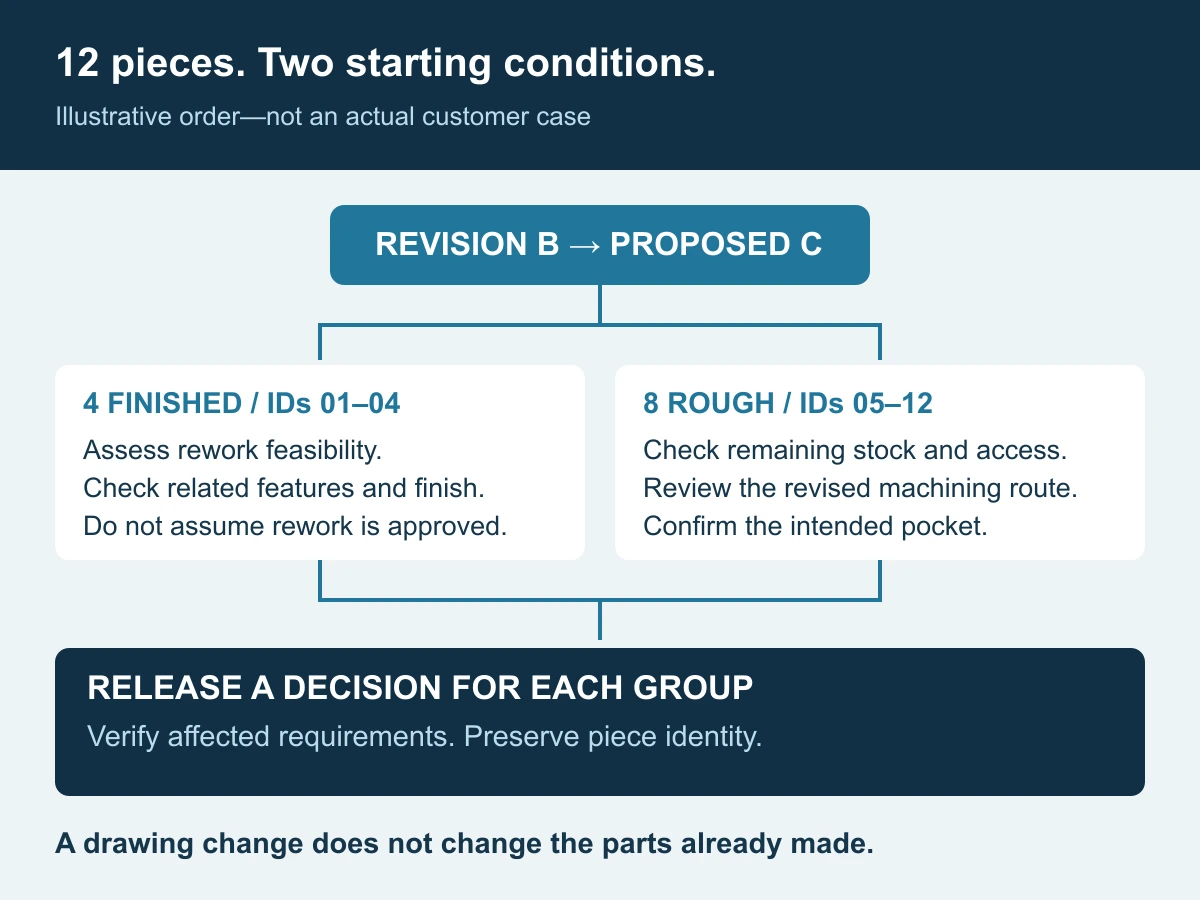
Illustrative example only—not a Huicheng customer case, quotation or machining recommendation.
A buyer ordered 12 inserts to revision B. Four identified pieces, 01–04, are already finish-ground. Pieces 05–12 remain rough-machined. The buyer proposes reducing a locating step height from 12.00 ±0.01 mm to 11.95 ±0.01 mm, measured from the same unchanged datum. The example assumes the new dimension has been selected by the responsible designer for the intended mating pocket.
The nominal reduction is 0.05 mm. That arithmetic alone does not authorize grinding the finished pieces. The supplier still needs to examine access, the actual starting dimensions, the adjacent seating surfaces and the effects of further work on other requirements.
- Identify and hold the affected work. Establish which pieces are at each stage and prevent unreviewed shipment or further processing of the changed feature.
- Review pieces 05–12. Determine whether the remaining stock and machining route can produce the proposed revision without compromising related features.
- Review pieces 01–04 separately. Assess rework feasibility. If these had a coating or a specially finished surface, include that condition in the review rather than treating them as bare-steel blanks.
- Release a piece-specific decision. The buyer and supplier may agree different dispositions for the two groups. Do not mix them under a single unsupported “all updated” statement.
- Verify and identify the resulting parts. Record the approved definition and relevant inspection evidence for each delivered group. If some remain revision B, identify their separately approved use.
The same logic matters for multi-cavity molds: a correction intended for pocket 3 is not automatically a global update to every nominally similar insert. If both geometries remain in use, consider a separately controlled variant or part number under the buyer’s identification rules, instead of relying on verbal pocket assignments.
7. A change-notice template buyers can copy
Use this as a communication aid and adapt it to your agreed approval process. It is not a contractual substitute or a claim that a particular form is mandatory.
Subject: Change review / manufacturing release — [part number], [PO and line]
Previous definition: [drawing ID/revision, model ID/revision, release reference].
Proposed definition: [new drawing/model and applicable specifications].
Change: [old requirement → new requirement, feature and reason].Applies to: [pieces, batch, quantity, tool/pockets and effective point].
Immediate instruction: [affected work to hold; unaffected work permitted to continue, if authorized].Supplier review requested: confirm current manufacturing state, rework/remake options, related feature impacts, revised inspection scope, charges and delivery effect.
Final release: [approved file set, disposition by piece/group, accepted scope and delivery, required evidence].
Authorized by: [name/role/date].
Supplier acknowledgement: [name/date and confirmation of the implemented scope].
For urgent work, authorize a specific activity and quantity; leave unresolved work on hold.
8. If you do not have a finished drawing, make approval part of the scope
Huicheng can manufacture custom precision mold inserts to customer-supplied drawings and can also help customers prepare drawings. When requesting drawing assistance, explain the insert’s function, mating conditions, known requirements and the information you can provide.
Agree who reviews the proposed drawing, who can approve functional changes and which version releases manufacturing. A draft prepared for discussion should remain distinguishable from an approved production definition. Drawing assistance does not remove the need to resolve missing pocket dimensions, uncertain sample wear or conflicting requirements.
Confirm the drawing-preparation scope, deliverable file formats, charges and revision allowance with the project quotation. Do not assume that design work, all future edits or reverse engineering of every feature is included in a machining price.
9. Close the change before shipment—and keep it usable for the next order
ISO 10007 provides configuration-management guidance across a product’s life, including responsibilities, identification, change control, status records and audits.[4] For a repeat insert purchase, the useful outcome is a clear record of what was actually delivered, not just what engineering intended to change.
Before dispatch, match each delivered group to its approved release, applicable inspection evidence and any authorized exceptions. Preserve the original records and document the basis for any evidence carried forward.
For the next order, send the applicable released packet and identify whether the spares are for the original or modified tool. “Same as last time” is not enough if the last shipment included multiple revisions or pocket-specific variants.
Frequently asked questions
Can I revise a mold insert after placing the order?
Yes, a change can be reviewed after ordering. Whether it is feasible, and at what cost or timing, depends on the changed requirement and work already completed. Obtain the supplier’s impact assessment and authorize the resulting scope before affected work resumes.
Does every drawing correction need a new part number?
Not necessarily. Apply your identification rules and assess compatibility. A documentation correction and a second geometry that must coexist in different pockets create different control needs. Make the intended application unambiguous whichever numbering approach is used.
Is an email approval sufficient?
It can serve as a recorded approval if your agreed process accepts it and it identifies the approver, files, affected scope and decision. A reply saying only “OK” to a long thread may leave those elements unclear.
Must every revision repeat a full first-article inspection?
Not automatically. Review the changed features and their interactions, then agree the necessary checks under the purchase requirements. An altered datum or treatment requirement can justify a wider review than a clerical correction. Do not assume that either all previous evidence is invalid or all of it remains sufficient.
Can we use the old revision for spare parts?
Only after confirming its suitability for the intended tool configuration and any relevant restrictions. Identify the permitted application so maintenance staff do not install an old-version spare into a modified pocket by mistake.
Sources and footnotes
The sources below support the stated document-control concepts. The mold-insert checklists, template and split-batch example are original practical applications, not reproduced standards requirements. Public standard descriptions were consulted, not the full purchased standards. These references do not claim Huicheng certification or NASA-specific process compliance. Use the editions and approval requirements agreed for your project.
- ASME. Y14.35 — Revision of Engineering Product Definition Datasets and Associated Documents. Public scope: revision identification and recording practices. Back to text ↑
- ASME. Y14.41 — Digital Product Definition Data Practices. Public scope: preparation and revision of digital product-definition data sets. Back to text ↑
- NASA. Systems Engineering Handbook, Section 6.5: Configuration Management, particularly change control and status documentation. NASA’s framework is context, not a mandatory mold-procurement procedure. Back to text ↑
- ISO/TC 176/SC 3. ISO 10007:2017 — Configuration management overview. Committee summary of responsibilities and configuration-management activities. Back to text ↑