Carbide is worth considering for a stamping punch when repeatable wear limits an otherwise stable operation and the resulting maintenance savings justify the complete tooling cost. It is not an automatic upgrade for a punch that chips or breaks unpredictably. In that case, establish the loading and failure mechanism before paying for a different material.
For buyers, the useful comparison is not “Which material is hardest?” It is “Which specified punch can produce the required accepted parts, with manageable maintenance and interruption risk?” This guide concerns sheet-metal piercing and blanking tooling. It is not a material-selection rule for injection-mold core pins, rotary cutting tools or forming punches.
Buy a material change against a defined failure mechanism and a measurable production result—not against an unspecified promise of longer life.
What changes when a steel punch is replaced with carbide?
Here, “carbide” means cemented tungsten carbide, not simply a carbide-containing tool steel or a thin coating. Dayton’s high-speed stamping guide describes carbide’s wear and compressive-load advantages, but also its vulnerability to chipping and breakage, more demanding sharpening, and sensitivity to punch–die misalignment.[1] Those are reasons to review the application, not a promise that every carbide grade outperforms every steel.
Do not approve the substitution from the working-tip outline alone. Ask whether the proposed construction retains the existing mounting arrangement or needs a coordinated redesign. Identify the supporting and locating interfaces, service method and any changes to the retained die or stripper. A “same-size replacement” and a redesigned station are different purchases.
| Buying question | Tool steel option | Carbide option |
|---|---|---|
| What exactly is being offered? | Named grade, treatment condition and agreed final hardness | Named manufacturer/grade and its documented properties |
| What must remain compatible? | Installed interfaces, cutting geometry and maintenance route | The same requirements, plus explicit review of the proposed construction |
| How will it be serviced? | Quoted sharpening scope, allowance and inspection | Confirmed carbide-capable service route, turnaround and inspection |
| What proves the purchase was worthwhile? | Accepted output and attributable cost under a documented, comparable production window | |
A maintenance route should be agreed before the purchase order. Establish who will service the part, what geometry may be restored, when it must be retired and how a spare will cover the turnaround. A quotation that omits this may understate the operating commitment even if its manufacturing price is clear.
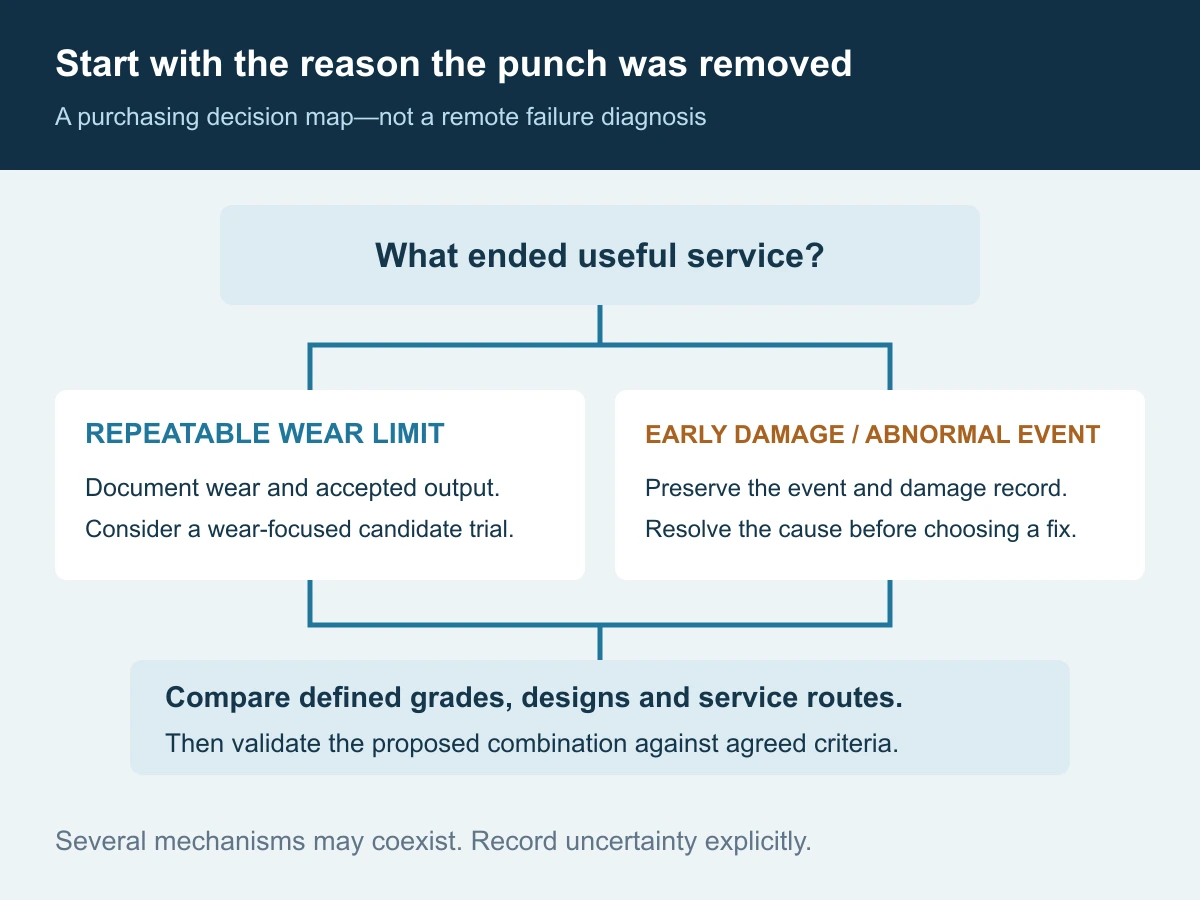
First distinguish predictable wear from an early failure event
“The punch does not last” is too broad to support material selection. Separate the reason the tool was removed from the number of strokes it accumulated. A punch retired at a controlled wear limit and one removed after a collision may have similar recorded life but require different corrective actions.
Dayton’s troubleshooting guide lists several contributors to chipping and point breakage, including lateral loading from misalignment, tight clearance, sharp corners, heat-treatment issues and a worn mating die.[2] A broken tip is therefore an observation, not proof that the previous grade lacked wear resistance.
| Observed pattern | What to document | Material decision to defer or investigate |
|---|---|---|
| Gradual edge deterioration at a repeatable output | Measured wear, part-quality trend and maintenance endpoint | A wear-focused candidate trial may be justified |
| Local chipping, especially early in a run | Exact edge location, first occurrence and mating condition | Investigate the local failure before specifying greater hardness |
| Material pickup or scoring | Deposits, sheet condition, lubricant and surface history | Do not classify pickup as simple abrasive wear without examination |
| Sudden break after an abnormal event | Station identity, event sequence and affected components | A material substitution alone is not a demonstrated correction |
This is an evidence-sorting aid, not a remote diagnosis. More than one mechanism can occur. Preserve the removed tooling and tagged samples instead of cleaning away the only evidence before review. Inspection, scrap clearing and tooling changes must follow the site’s authorized isolation, stored-energy control and press-safety procedures; do not inspect inside a cycling press.
Do not compare one generic “steel” with one generic “carbide”
Tool steel is not a single performance level. For example, Uddeholm describes Vanadis 4 Extra SuperClean as a powder-metallurgical cold-work steel balancing wear resistance and ductility, with applications involving chipping and demanding blanking conditions.[3] This illustrates why an appropriate steel alternative belongs in the shortlist; it is not a recommendation of that grade for every punch or a claim that Huicheng stocks it.
Likewise, Hyperion’s stamping-blank brochure lists distinct carbide grades with different grain sizes, hardness, fracture-toughness and transverse-rupture-strength data.[4] A quotation saying only “tungsten carbide” leaves the material insufficiently defined for an engineering comparison.
Request the exact grade and the current supplier data sheet. Keep hardness values attached to their test scale and conditions: a carbide value in HRA or HV is not a steel value in HRC. Do not rank quotations by the raw numbers or treat a hardness conversion as a measure of toughness. Separately reported properties answer different questions.
For steel, identify the grade, final treatment condition and agreed hardness requirement. For carbide, identify the manufacturer and grade, applicable property specification and finished-component requirements. Do not carry a steel hardening-and-tempering instruction over to cemented carbide. Where an alternative grade is proposed, require approval rather than accepting an unspecified “equivalent.”
The RFQ should also say whether the component is a solid part or an assembly with a distinct working element. If construction changes, request a revised drawing and interface review. Do not assume a new material can be inserted into an unchanged design without checking the complete arrangement.
Compare cost per accepted part, not purchase price or raw stroke count
Use a common production window with the same required output and quality limits. Our suggested accounting model is:
= (allocated tooling cost + servicing cost + attributable downtime cost + attributable quality-loss cost) ÷ accepted parts
This is a comparison framework, not a universal costing standard. Include the costs that change between options, apply the same allocation rules and avoid double counting. If a punch remains usable after the campaign, account for its remaining value consistently rather than automatically charging its full purchase price to that campaign. Common production costs are omitted only if they are genuinely unchanged.
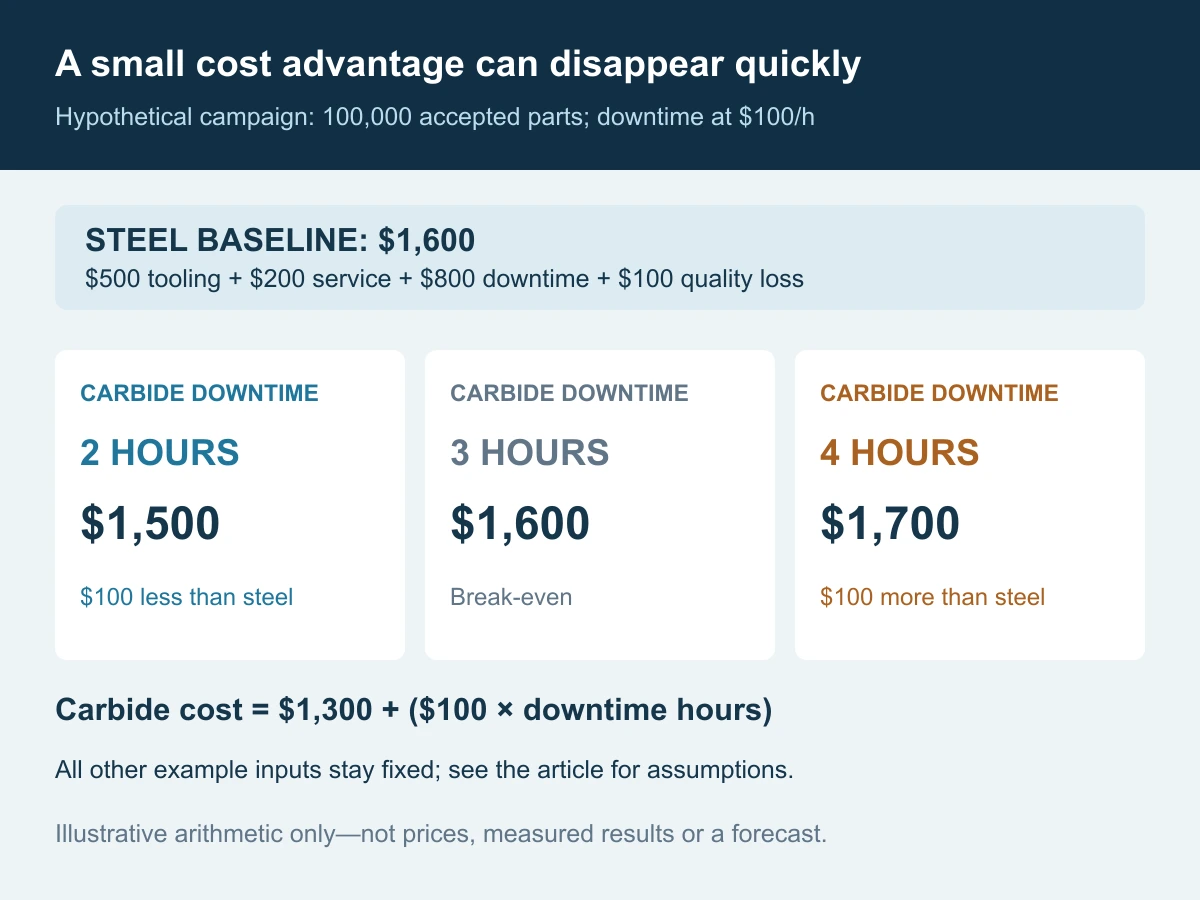
Illustrative example only—not Huicheng prices or measured tool-life data: both options deliver 100,000 accepted parts. Assume attributable downtime is valued at US$100 per hour.
| Cost over the same campaign | Steel candidate | Carbide candidate |
|---|---|---|
| Allocated tooling cost | $500 | $1,100 |
| Servicing | $200 | $100 |
| Attributable downtime | 8 h × $100 = $800 | 2 h × $100 = $200 |
| Attributable quality loss | $100 | $100 |
| Total | $1,600 | $1,500 |
| Per 1,000 accepted parts | $16 | $15 |
The carbide candidate costs $600 more in allocated tooling but saves $100 in service and $600 in downtime. Its net advantage is only $100—not a dramatic saving. Under these assumptions, it needs to save more than five downtime hours to be cheaper; at three carbide downtime hours the options break even. At four hours, carbide totals $1,700 and loses the comparison.
That sensitivity is the purchasing insight: a small estimated advantage should not be sold internally as a guaranteed return. Identify which assumption controls the result and measure it during the trial. If one option changes throughput, scrap or other operating costs, expand the model accordingly.
Design the trial so “longer life” has a useful meaning
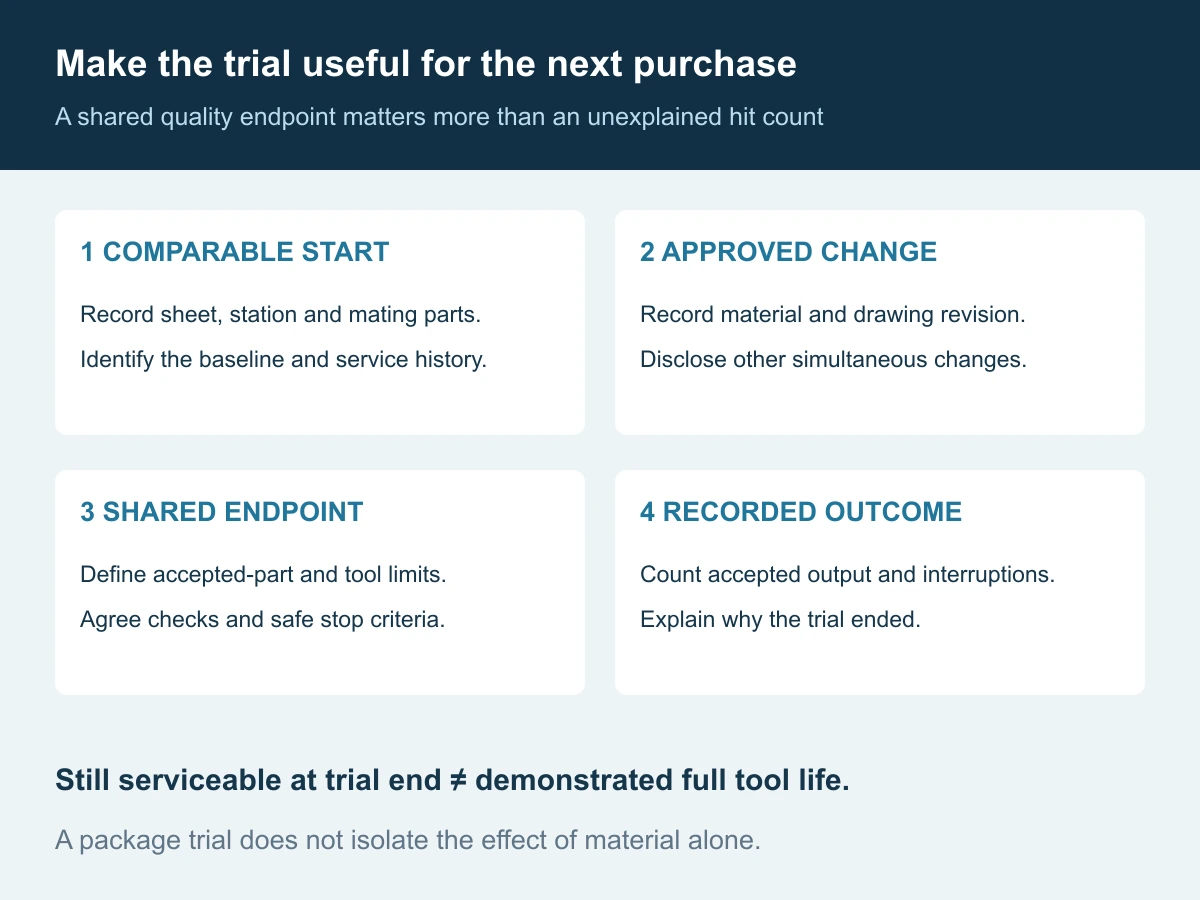
Set the endpoint before the trial. Examples include a specified product-quality limit, an agreed tool-wear limit or a defined maintenance trigger. Count accepted parts as well as strokes, and distinguish an initial run before sharpening from cumulative service across multiple approved regrinds.
A trial stopped because the production order ended has not demonstrated the punch’s full life. Record the accepted output achieved and that the tool was still serviceable. Conversely, a trial stopped for an unrelated feed problem should not be reported as ordinary wear-out without explaining the event.
- Define the baseline: current punch and die revisions, material grades, service history and recent removal reasons.
- Record the operating window: sheet grade, condition and thickness range; relevant press settings; lubrication; station and mating-tool condition.
- Identify the change: material only, or a package including geometry, coating, mounting or process changes.
- Set observation and stop criteria: agreed part checks, inspection intervals, maintenance limits and abnormal-event response.
- Close the record: accepted output, rejection reasons, service time, attributable downtime, end condition and remaining uncertainty.
When several variables change together, a successful trial validates the tested package, not carbide alone. Where practical, use a controlled comparison. Multiple representative runs provide more useful evidence than the best single run, especially when the existing problem is intermittent. Choose the trial scope with the responsible tooling and quality teams; this guide specifies no universal number of test strokes.
What should go into a carbide-versus-steel punch RFQ?
Ask for two defined proposals against the same job, not two prices against a material label. Supply the controlled component drawing plus enough application information to explain why an alternative is being considered.
- Cutting task: piercing or blanking, sheet specification, thickness range, required profile and finished-part acceptance criteria.
- Existing configuration: punch and die revisions, clearance convention, mounting and support details, and relevant stripper information.
- Performance record: removal reason, accepted output, sharpening history and location-tagged damage evidence where available.
- Candidate definition: actual material grade, construction, treatment or finishing requirements, and the proposed differences from the baseline.
- Commercial scope: component manufacture, drawing work, inspection records, spare quantities, service route and lead time.
- Validation responsibility: who provides the press, material and trial personnel; who approves the result; and which costs are included.
For Huicheng’s custom stamping punches and die components, send the current drawing and the reason for considering a material change. Huicheng can manufacture to customer drawings and help customers prepare drawings. Where the existing definition is incomplete, agree the drawing-development scope and approve the resulting requirements before manufacture.
Specific material availability, carbide grade and construction, specialist inspection and production-trial arrangements must be confirmed for the project. A quoted component is not automatically a complete die redesign or an in-house press trial. Do not assume a guaranteed number of hits unless a separate, applicable performance commitment has been agreed.
The best outcome is a repeatable purchasing specification: the selected material and revision, why it was chosen, the conditions validated and the maintenance plan. That turns the next reorder into an evidence-based decision rather than another request for “something harder.”
Frequently asked questions
Is carbide always better for high-volume stamping?
No. Volume makes maintenance economics important, but it does not establish that wear is the limiting mechanism or that the proposed design and material combination will work. Compare the actual candidates under the intended conditions.
Should a chipped steel punch simply be replaced with carbide?
Not without review. Establish the location and timing of damage, the surrounding tooling condition and any abnormal event. The material change should address an identified need, not replace the investigation.
Can two carbide grades be considered equivalent because their hardness matches?
No. Matching one property is not a complete equivalence assessment. Obtain the grade documentation and review the requirements relevant to the component before approving substitution.
What is the most useful trial result for a buyer?
A traceable record of accepted output, removal or stop reason, maintenance and downtime under stated conditions. A raw stroke count without a quality endpoint is insufficient for a cost comparison.
References and scope notes
The primary sources below support the specific material and troubleshooting principles cited. The RFQ framework, trial plan, diagrams and cost example are editorial tools, not Huicheng case results. Supplier-specific grade recommendations and performance claims are not transferred to another application.
- Dayton Progress: High Speed Stamping, pages 14–15 — carbide tradeoffs, servicing and alignment. This older application guide is used for principles, not universal grade percentages or setup values. ↩
- Dayton Lamina: Problem Solving Guide — multiple possible contributors to punch chipping and breakage; not a diagnosis of an individual component. ↩
- Uddeholm: Vanadis 4 Extra SuperClean, page 3 — an example of a PM tool steel balancing wear resistance and ductility; no universal material recommendation is implied. ↩
- Hyperion Materials & Technologies: Cemented Carbide Stamping Tool Blanks, page 3 — grade-specific property reporting and differing hardness scales. Obtain current grade data for an actual order. ↩