One mold cavity may require several EDM electrodes because bulk removal, final detail, local access and repeat machining do not always have the same requirements. However, neither a larger electrode count nor a smaller one proves that a quotation is better. Each electrode should have a defined job, and the price should cover an agreed finished result.
This guide is for buyers and tooling engineers reviewing sinker EDM for mold components. It focuses on shaped electrodes, not the traveling wire used in wire EDM. The practical question is not simply “How many electrodes are included?” It is “What does each electrode accomplish, and what happens if the planned set cannot complete the accepted parts?”
Compare the cost and responsibility for an accepted cavity—not the number of electrode blocks. Ask for a feature-to-electrode map, clear finishing scope and agreed terms for additional electrodes.
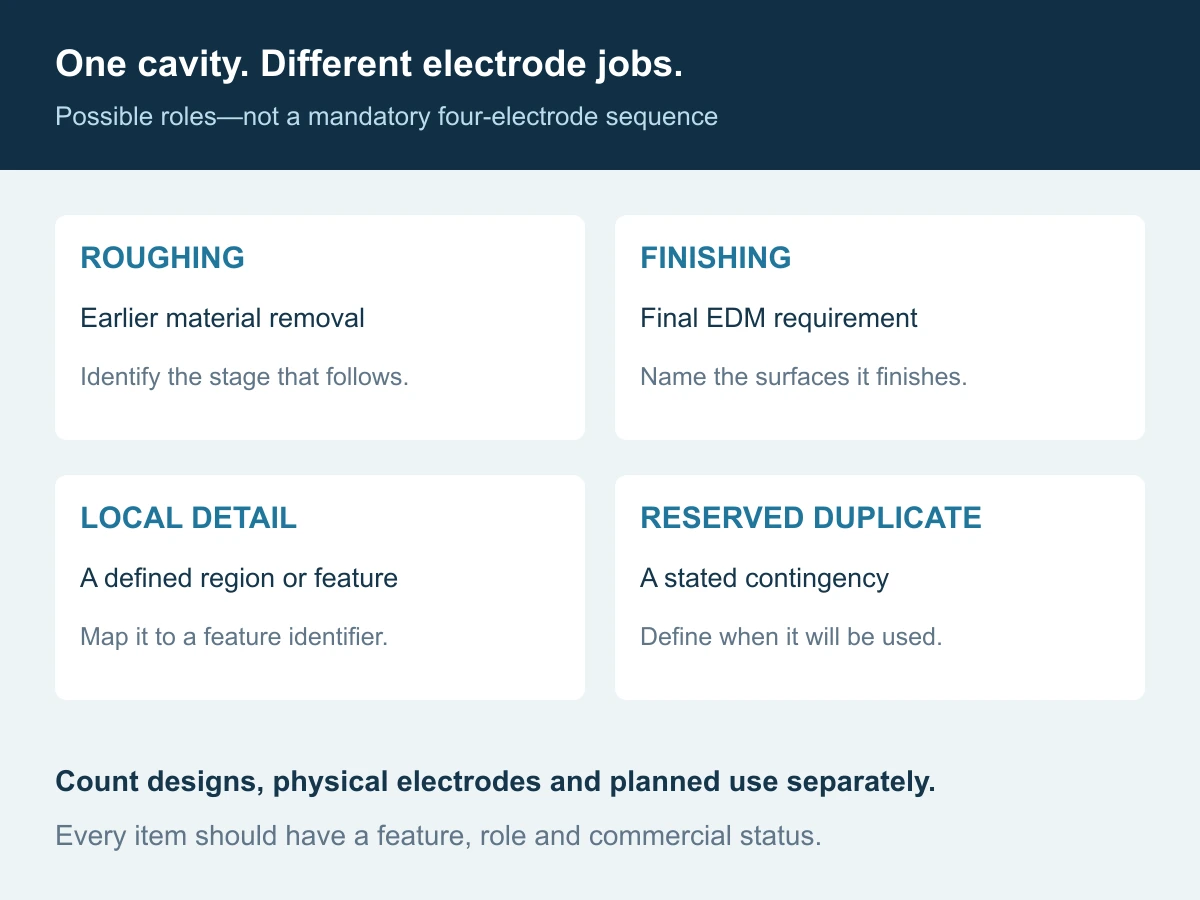
Why might one cavity need more than one electrode?
Separate roughing and finishing electrodes can divide bulk removal from final detail. A local electrode may address only one area rather than the entire cavity. POCO’s technical manual describes staged and partial-area electrode approaches and identifies flushing as a design consideration.[1]
Translate that process logic into four distinct quotation labels:
- Roughing: intended for an earlier material-removal stage, with the required later finishing work still to follow.
- Finishing: assigned to the final EDM geometry or surface requirement.
- Local detail: assigned to identified features, such as one narrow region, not automatically a duplicate of the main electrode.
- Reserved duplicate: held for a stated contingency or quantity requirement; distinguish it from an electrode expected to be consumed during normal production.
These are possible roles, not a universal recipe. Some jobs combine roles in one electrode. Others need several electrodes within one role. A quotation that says “four electrodes” leaves both possibilities unresolved.
Our recommendation: require an explanation when an electrode is added, removed or reassigned. “Protect the finish on feature F2” is a useful reason. “This is our usual quantity” is not enough to compare two different process plans.
Why is electrode size different from finished cavity size?
Sinker EDM operates across a spark gap between a shaped electrode and a conductive workpiece in dielectric fluid. The electrode does not mechanically press its exact dimensions into the steel. Makino’s explanation of ram EDM identifies that gap as part of the process.[2]
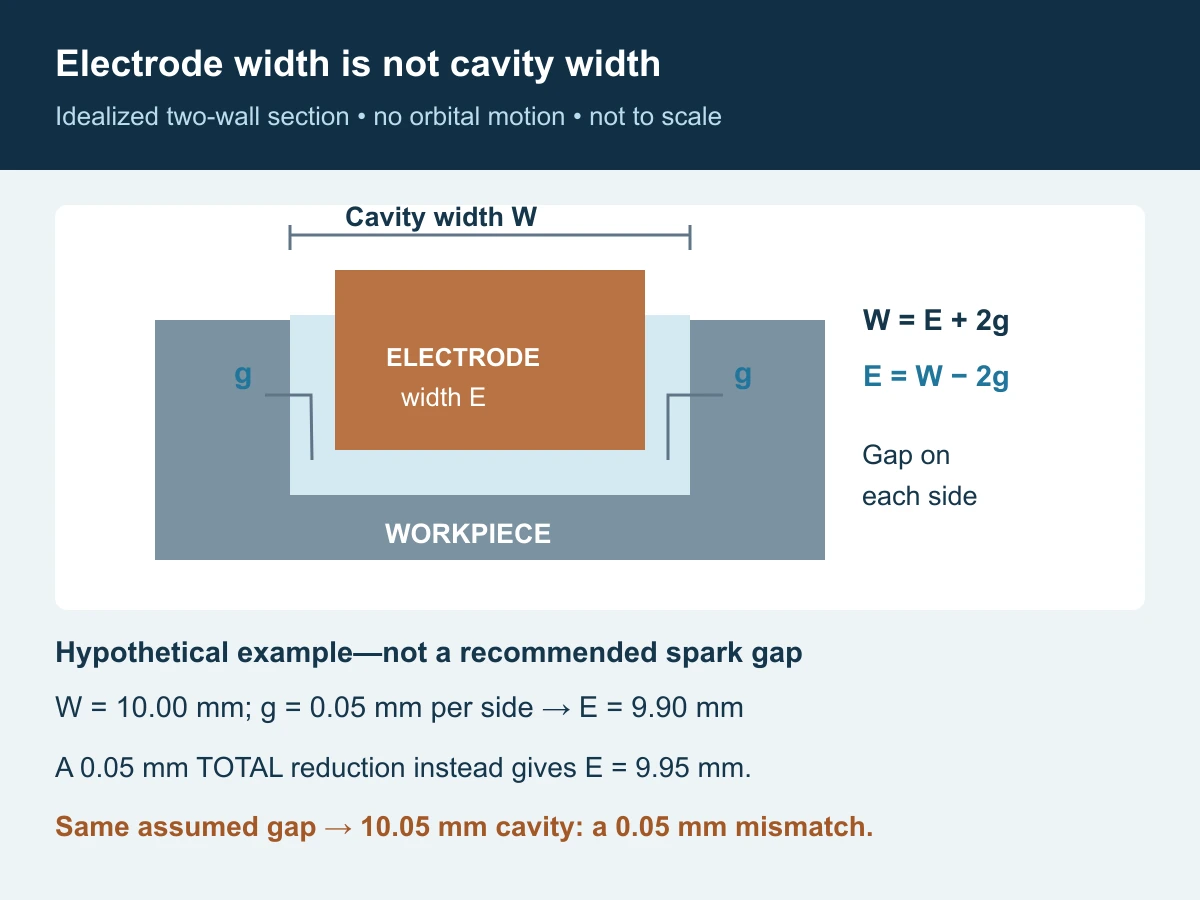
This creates a documentation trap: “undersize” is incomplete without a definition. Does a stated value mean a reduction on each side, a total reduction across the feature, or an offset already included in the electrode model? Is it a simplified spark-gap allowance, or does the process plan also include orbital motion and stock for later operations?
Consider an intentionally simplified, non-orbiting section with two parallel walls. If the target EDM width is W and the assumed side gap is g, then the ideal electrode width is E = W − 2g. This geometry ignores wear, taper, positioning error and subsequent material removal. It is an explanation of the two-sided relationship, not an electrode-design instruction.
For example, suppose an engineer deliberately assumes W = 10.00 mm and g = 0.05 mm per side. The idealized E is 9.90 mm. If “0.05 mm undersize” were instead interpreted as a total reduction, E would be 9.95 mm. Under the same assumed gap, that would imply a 10.05 mm cavity—not 10.00 mm. All values here are hypothetical; 0.05 mm is not a recommended machine setting.
The purchaser should approve the required finished geometry. The responsible process engineer should define the electrode offsets and machining strategy. Do not shrink the customer’s finished-part model as an informal shortcut.
Should buyers specify copper or graphite?
Specify a material when there is a documented project reason, such as an approved process or an electrode supplied for an existing setup. Otherwise, ask the supplier to justify the selection against the feature and acceptance requirements.
“Graphite” is not a complete grade specification. Entegris’s selection guide distinguishes graphite grades by properties and intended applications; it also lists copper-infiltrated graphite, which should not be confused with a solid copper electrode.[3] A nominal particle-size value is a material descriptor, not a promise of the finished cavity’s tolerance or roughness.
POCO identifies material removal rate, wear, surface finish, machinability and material cost as linked selection factors. Its manual also distinguishes end, side, corner and volumetric wear.[4] “Low wear” therefore needs context: preserving overall length is not the same question as preserving a small functional corner.
A useful request is: “Explain which requirement drives the proposed electrode material, which detail is most vulnerable, and how the finished feature will be checked.” Avoid unsupported shortcuts such as “graphite is always faster,” “copper always produces the best finish,” or “a premium grade eliminates the need for finishing electrodes.”
Ask for a feature-to-electrode map, not a shopping list
The following is an illustrative planning template for a cavity with a main pocket and a local narrow feature. The identifiers and roles are examples, not an actual Huicheng job or a claim that every cavity needs this set.
| Electrode ID | Assigned job | What the plan should record | Commercial clarification |
|---|---|---|---|
| E-R1 | Main pocket: earlier removal stage | Feature IDs, revision and subsequent finishing stage | Included in normal production? |
| E-F1 | Main pocket: final EDM stage | Final EDM condition and surfaces checked afterward | Is downstream polishing included or separate? |
| E-D1 | Local narrow feature | Local geometry and its relationship to the main pocket | Does the quoted count include this separate feature? |
| E-F2 | Reserved finishing duplicate, if justified | Release condition and intended remaining use | Charged upfront, only if used, or retained by agreement? |
Add the drawing/model revision, electrode material and grade, locating references, quantity of components covered, and the party responsible for approval. The supplier can keep proprietary machine settings in its internal process sheet; the buyer still needs a clear explanation of scope.
The useful insight is that a count hides three different numbers: distinct electrode designs, physical electrodes manufactured, and physical electrodes planned for use on this order. For example, two designs made as three physical electrodes are not “three different designs.” Separating these numbers helps prevent a duplicate being charged as fresh engineering without explanation.
How should you compare the cost of two electrode plans?
First normalize the finished-part revision, order quantity, final surface condition and acceptance requirements. Then compare the complete route. The following cost structure is a purchasing tool, not an industry pricing formula:
Comparable quoted total = electrode engineering and manufacture + setup and EDM + agreed downstream finishing + agreed inspection + explicitly included contingency.
Illustrative arithmetic shows why electrode price alone can mislead. Plan A quotes 600 currency units for electrodes and 900 for setup/EDM; Plan B quotes 900 and 650 respectively. A totals 1,500; B totals 1,550. B would need at least 50 units of demonstrated savings elsewhere merely to reach parity. More electrodes do not make B better, and fewer do not make A safer.
Now ask whether both totals include the same finishing, quantity and reports. If one excludes an operation, the arithmetic is not yet a fair comparison. If a supplier claims the more expensive plan reduces rework risk, ask what evidence supports that claim; do not invent a failure probability to make the numbers work.
- Normal process consumption: clarify whether additional electrodes needed to achieve the unchanged accepted scope remain the supplier’s responsibility.
- Customer changes: define how a new revision, extra component or changed surface requirement triggers a revised quotation.
- Unresolved feasibility: identify any paid trial stage and the decision point before committing to the full order.
These are terms to negotiate, not automatic legal obligations. A fixed-price completed component and a time-and-materials development job allocate risk differently. The quotation should say which one is being purchased.
What proves the electrode plan worked?
An electrode report supports process control; it does not replace acceptance of the finished mold component. We recommend three linked records so a buyer can distinguish a manufacturing input from a delivered result.
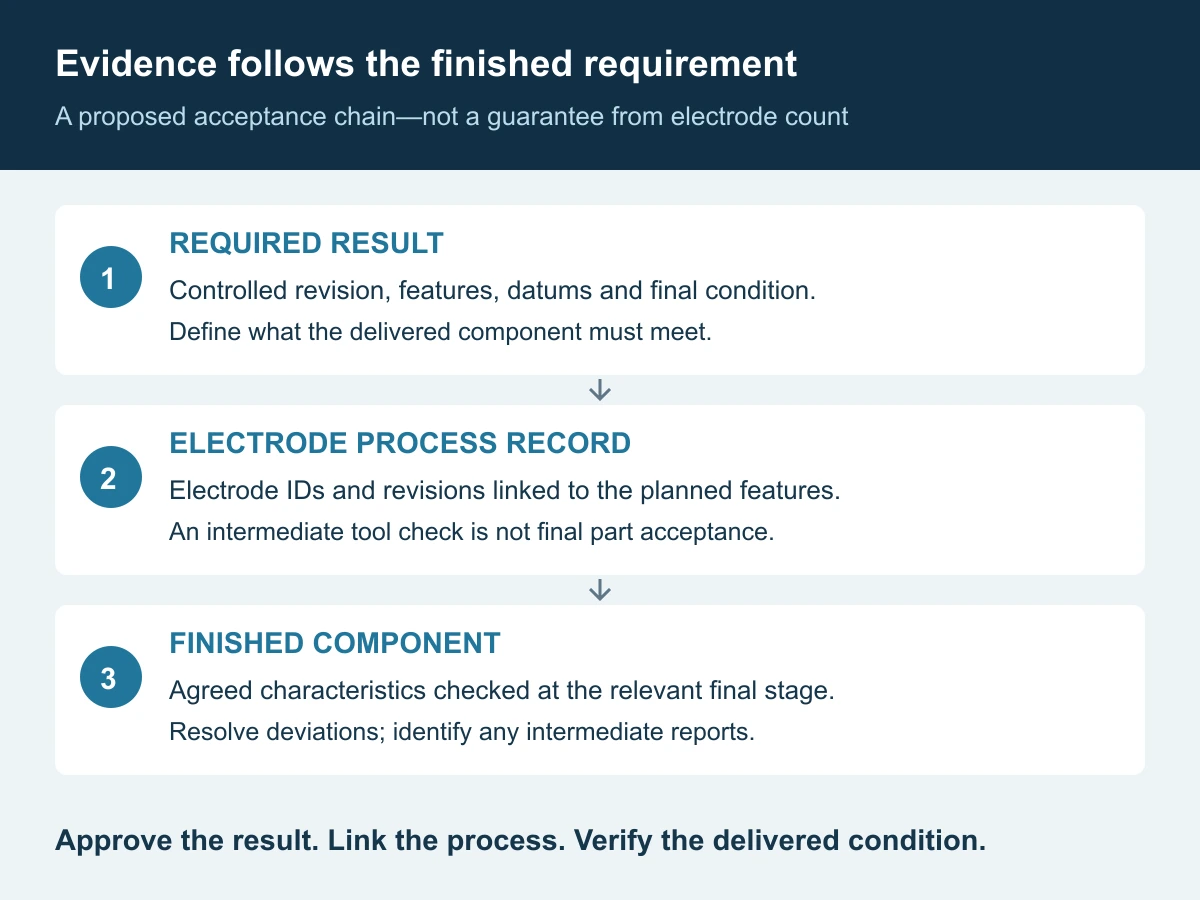
- Required result: identify the controlled revision, feature IDs, datums and final condition—including any operation after EDM.
- Process record: link the electrode IDs and revisions to those features, with the checks and exceptions agreed for the order.
- Delivered result: report the specified component characteristics after the relevant final operation, with any deviation resolved explicitly.
Before ordering, ask how the critical local geometry will actually be measured. “CMM report included” is not a complete answer if the specified surface cannot be accessed by the proposed probe. Agree the measurement method and reporting scope rather than assuming every listed feature will appear in the report.
Where polishing follows EDM, label an EDM-stage result as intermediate. Where the surface is delivered as-EDMed, make that acceptance state explicit. A buyer should never have to infer whether a measurement belongs to the supplied condition or an earlier manufacturing stage.
What should happen to electrodes after delivery?
A retained electrode is a potential production asset, not a guarantee of a repeatable future order. Before relying on reuse, request its identity, compatible revision, condition and the supplier’s assessment of suitability for the proposed next job. A physically intact electrode may still be inappropriate after a geometry change.
Agree whether the quotation includes ownership, storage, retrieval, inspection before reuse and eventual disposal. Also distinguish physical electrodes from their design files, programs and fixtures; payment for one does not, by itself, define delivery of the others.
For repeat purchasing, our recommended record is simple: electrode ID, design revision, last use, status and agreed retention terms. Do not request indefinite storage merely to obtain a reassuring “spares available” note. Set a retention period that matches the expected reorder pattern.
Frequently asked questions
Does a high electrode count mean the supplier is overcharging?
No. Request the role and feature assignment for each electrode, then compare the total accepted scope. Unexplained quantity is a reason to ask questions, not proof of overcharging.
Can one electrode be used for both roughing and finishing?
It can be part of a valid plan for some jobs. Ask the supplier how that plan meets the final feature requirements. Separate electrodes are a process choice, not a universal purchasing rule.
Should I put the spark gap on the mold component drawing?
Keep final component requirements distinct from process allowances. If you are also supplying or approving the electrode design, its controlled documentation should state how offsets are defined and who approves them.
What if we do not have a complete drawing?
Huicheng can manufacture to customer drawings and help customers prepare drawings. Send the available geometry, mating information and functional requirements for review. Agree the drawing-development scope and approve the resulting revision before electrode manufacture; incomplete inputs should not be presented as a production-ready specification.
Request an EDM review with a clear electrode scope
For Huicheng’s EDM, electrode manufacturing and wire EDM services, provide the component drawing or available design inputs, material condition, order quantity, critical features and required final surface state. Identify whether you are buying finished components, electrode support or both so the quotation can define the actual deliverables.
Ask for the electrode roles, the quantity covered and the rules for changes or additional consumption. The goal is not to purchase the maximum number of electrodes. It is to approve a traceable plan for producing the required component without leaving the finishing work, acceptance evidence or commercial responsibility ambiguous.
References and technical notes
Manufacturer references support the stated process principles; they do not establish Huicheng-specific tolerances, prices or cycle-time guarantees. The electrode map, cost comparison and purchasing recommendations are editorial analysis. All numerical examples and diagrams are illustrative.
- POCO EDM Technical Manual, Chapter 9: Electrode Design Considerations — staged and partial-area electrodes; planning for flushing. ↩
- Makino: The Case for Additive Technology in EDM — cited for the basic ram-EDM process and spark gap only, not as a current universal surface-finish limit. ↩
- Entegris: EDM Graphite Selection Guide — grade distinctions and application context. ↩
- POCO EDM Technical Manual, Chapter 6: Five Key Factors in Electrode Material Selection — material-selection factors and categories of electrode wear. ↩