EDM, Electrodes
& Wire EDM.
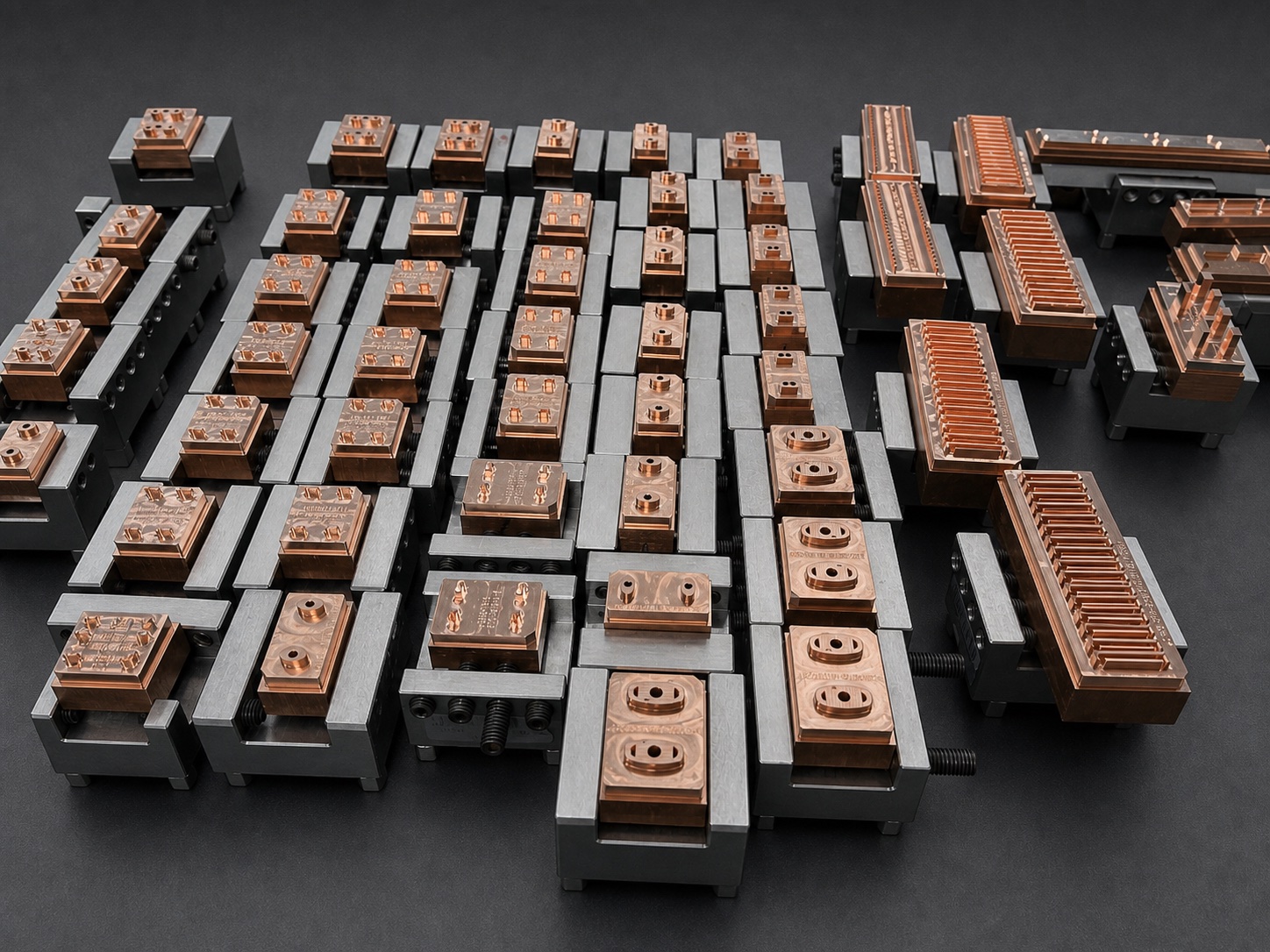
Electrode machining, spark erosion and wire cutting are coordinated with the same drawing and datum plan used for CNC, grinding and final inspection.
Use EDM for a reason,
not as a default.
EDM is useful for deep ribs, internal details, hardened steel and features that rotating tools cannot reach. Wire EDM is used for conductive components requiring controlled profiles, slots or through-features.
Equipment precision entry: 0.001–0.003 mm.
Equipment precision entry: 0.002–0.005 mm.
Equipment precision entry: 0.001–0.003 mm.
Equipment precision entry: 0.001–0.003 mm.
Cost-optimized wire EDM for general profiles.
High-speed electrode manufacturing with precision control.
Geometry, spark gap
and inspection stay connected.
Feature review
Confirm geometry, datum references, access and finish.
Electrode planning
Select electrode strategy, material and allowance.
Electrode machining
Machine electrode to the controlled program.
Pre-EDM inspection
Check electrode by CMM before use.
EDM & final check
Run EDM stages, then inspect finished feature.
Hardened tool steel
and conductive materials.
EDM and wire EDM are suitable for any electrically conductive material. Huicheng regularly processes hardened tool steels, high-speed steels, stainless steels, copper alloys and tungsten carbide. Material hardness does not affect EDM processing difficulty—we can machine hardened materials up to HRC 65 with the same stable tolerance.
Deep cavities, small radii,
and post-hardening features.
EDM should be specified when CNC or grinding cannot access the feature, or when machining after heat treatment is required. Common applications include deep narrow slots, internal corners with tight radii, blind cavities in hardened inserts, and fine ribs in connector molds.
Deep narrow slots & ribs
When depth-to-width ratio exceeds 5:1 or internal access is restricted, EDM can reach features that rotating tools cannot. Typical examples: cooling channels in hot-runner molds, narrow ejector slots, and internal ribs in connector cavities.
Sharp internal corners & small radii
EDM can produce internal radii as small as R0.01 mm, which is impractical with rotating cutters. This is essential for mold cores, punch profiles, and connector pin details where sharp corners control part geometry.
Hardened steel machining
After heat treatment (HRC 50+), most tool steels become difficult or impossible to machine by conventional methods. EDM allows post-hardening corrections, modifications, and feature additions without risking cracking or distortion.
Complex 3D profiles
Wire EDM produces controlled through-profiles with perpendicular or tapered walls. Common applications: stamping punches, progressive die strippers, connector cavities, and ejector blade profiles.
Stable results
from verified processes.
Huicheng’s standard EDM tolerance is 0.002–0.005 mm for typical features. Tighter tolerances are evaluated case-by-case based on geometry, depth, material and inspection requirements. Surface finish depends on spark parameters, electrode material and number of finishing passes.
All critical EDM features are inspected by CMM or optical comparator after machining. Electrode dimensions are verified before use. Spark gap allowance and electrode wear compensation are calculated based on material, feature depth and finish requirements.
EDM process clarification
When should I choose EDM instead of CNC machining?
Choose EDM when: (1) features are too deep or narrow for rotating tools, (2) material is hardened above HRC 50, (3) internal corners require radii smaller than R0.5 mm, (4) modifications are needed after heat treatment, or (5) cutting forces would distort thin walls. For general prismatic features in softer materials, CNC is faster and more economical.
How do you control spark gap and electrode wear?
Spark gap allowance is calculated based on electrode material (copper or graphite), feature geometry, and surface finish requirements. Electrodes are pre-inspected by CMM before use. Electrode wear is compensated through multi-stage roughing and finishing passes. Critical dimensions are verified after EDM by CMM inspection against the original drawing datums.
What is the difference between slow-wire and mid-wire EDM?
Slow-wire EDM (Seibu, Charmilles) uses fine brass wire with multiple finishing passes, achieving Ra 0.3 μm and ±0.02 mm tolerance. Mid-wire EDM uses molybdenum wire with fewer passes, suitable for general profiles where Ra ≥ 0.8 μm is acceptable. Slow-wire is specified for tight-tolerance stamping punches and connector cavities; mid-wire is cost-effective for ejector blades and general slots.
Can EDM be used on non-conductive materials?
No. EDM requires electrical conductivity. It cannot process ceramics, plastics, or pure aluminum oxide. All tool steels, stainless steels, copper alloys, and carbides are conductive and suitable for EDM. If your component is non-conductive, we will recommend CNC or grinding instead.
Do you provide electrode design and manufacturing in-house?
Yes. Electrode design, material selection, machining, and pre-EDM inspection are all handled in-house. We use Jingdiao high-speed CNC machines for electrode manufacturing and verify electrode dimensions by CMM before use. Electrode strategy (single or multiple electrodes, roughing/finishing separation) is planned during the feature review stage.
What inspection is included with EDM machining?
Standard inspection includes caliper and micrometer checks for general dimensions. For critical features, we provide CMM measurement reports showing actual dimensions against drawing tolerances and datums. Optical comparator (2.5D) is used for profile verification. Surface finish can be measured and documented if specified on the drawing.
Have a difficult internal feature?
Send the drawing and identify the surfaces, datums and finish that control function.