Mold Trial & Injection Molding
validate, optimize, document.
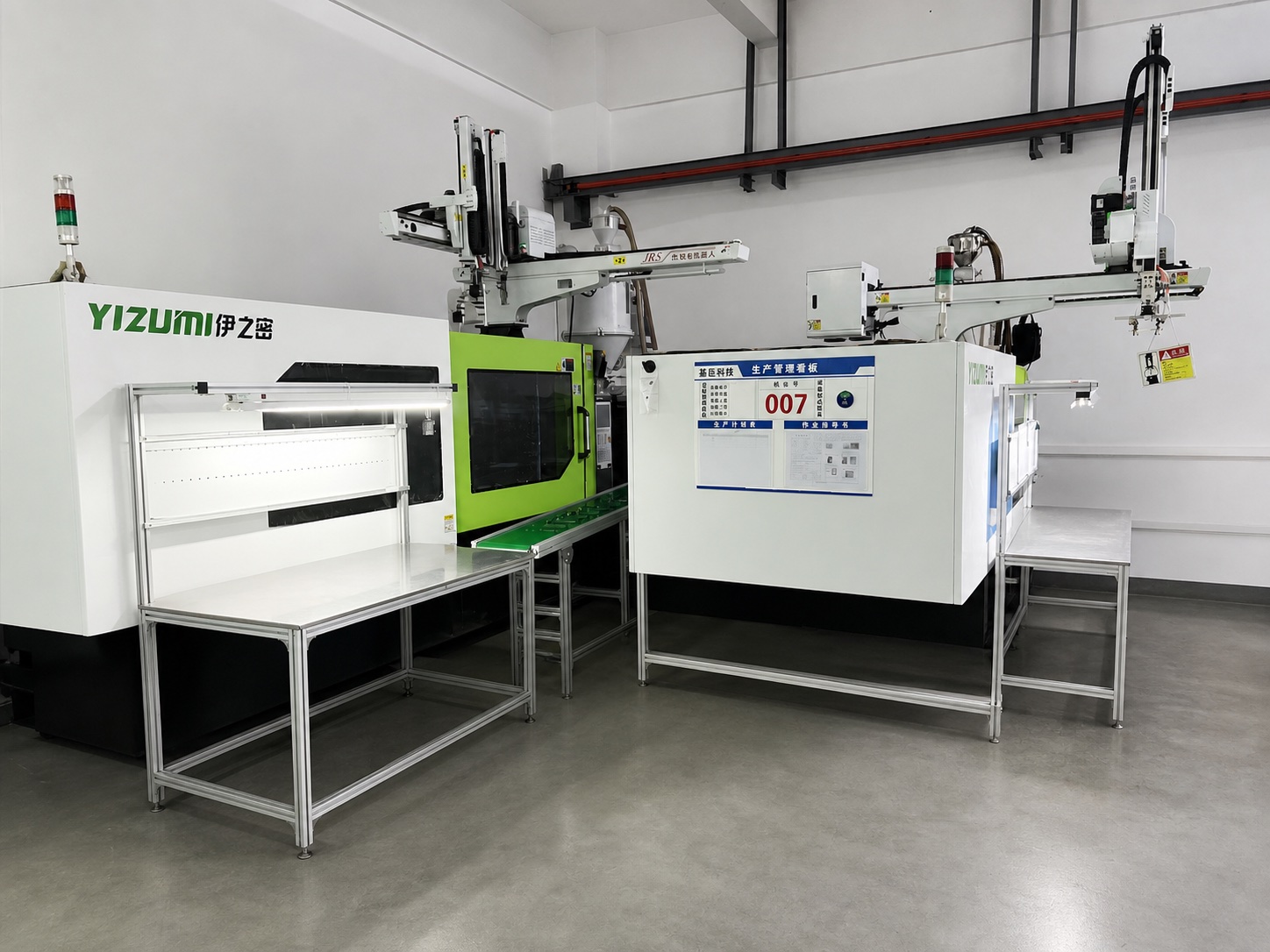
Huicheng provides mold trial services with 120T, 200T and 320T injection molding machines to validate new molds, optimize cycle parameters, troubleshoot molding defects and support small-volume production. Trial services include material testing, cooling balance adjustment, dimensional inspection and documented machine settings for production handover.
From first-shot validation
to production-ready parameters.
Mold trials verify that a newly manufactured or modified mold can produce acceptable plastic parts under controlled injection conditions. Trial objectives include confirming fill completeness (no short shots), eliminating flash, controlling sink marks and warpage, achieving dimensional tolerances, optimizing cooling time and documenting machine settings for production handover.
Huicheng’s injection molding capability supports both internal mold trial (for molds manufactured by Huicheng) and external mold trial (for customer-owned molds requiring validation, troubleshooting or parameter optimization). Services include material testing with customer-specified resins, multi-iteration parameter adjustment, part inspection and defect root-cause analysis. Trial shot samples, documented machine settings and recommended production parameters are provided with every completed trial.
Clamping force: 120 tons · Shot size: up to 180g · Platen size: 450 × 450 mm · PC-specific screw · Mold trial and small-volume production
Clamping force: 200 tons · Shot size: up to 320g · Platen size: 550 × 550 mm · PC-specific screw · Mid-size component trials and production support
Clamping force: 320 tons · Shot size: up to 580g · Platen size: 680 × 680 mm · PC-specific screw · Larger tool validation and high-cavity-count molds
Part removal automation · Insert loading · Secondary operation integration · Reduces cycle time and operator dependency
Precise mold temperature control · Heating and cooling capability · Multi-zone control for complex molds
Desiccant and hot-air dryers · Pre-drying for hygroscopic materials (PA, PC, PBT, PET) · Moisture control for dimensional stability
All injection machines support standard mold bases (LKM, HASCO, DME equivalent) and custom mold configurations. Hot runner temperature control and multi-zone cooling are available.
Systematic validation
from first shot to production handover.
Effective mold trials follow a structured sequence: mount the mold, establish baseline parameters, iterate adjustments, inspect parts, document results and hand over production-ready settings.
Mold inspection and mounting
Inspect mold for damage, verify cooling line connections, install locating ring, mount mold on injection machine platen, connect cooling lines and hot runner temperature controller (if applicable). Verify mold alignment and clamp force distribution.
Material preparation and drying
Confirm customer-specified plastic material grade and color. Pre-dry hygroscopic materials (PA, PC, PBT) per resin supplier recommendation. Load material into hopper and purge barrel with trial material until color and melt consistency are stable.
Baseline parameter setup
Set initial injection speed, injection pressure, holding pressure, holding time, cooling time and mold temperature based on resin supplier datasheet and mold geometry. Run first shots at conservative settings to avoid mold damage or material degradation.
First-shot inspection and short-shot analysis
Inspect first shots for fill completeness, flash, sink marks, weld lines, gate vestige and ejection marks. If short shots occur, increase injection pressure or speed. If flash occurs, reduce injection pressure or verify parting line fit. Document defects with photographs.
Parameter iteration and cooling balance
Iterate injection speed, pressure, holding time and cooling time to eliminate defects and minimize cycle time. Adjust mold temperature and cooling water flow rate to balance cooling across multiple cavities. Monitor part warpage and dimensional stability across multiple cycles.
Dimensional inspection and defect root-cause analysis
Measure critical part dimensions with calipers, micrometers or CMM. Compare measured dimensions to part drawing tolerances. If dimensions are out of spec, analyze root cause: insufficient packing pressure, non-uniform cooling, mold dimension error or material shrinkage variation.
Trial shot sampling and documentation
Run 20–50 consecutive production-equivalent shots to verify process stability. Collect trial shot samples (typically 5–10 parts) for customer inspection. Document final machine settings: injection speed, pressure, holding pressure, holding time, cooling time, mold temperature, barrel temperature profile and cycle time.
Production handover and follow-up support
Provide trial report with documented machine settings, trial shot samples, defect photographs (if any), dimensional inspection results and recommended production parameters. For molds transitioning to external production facilities, provide setup guidance and follow-up troubleshooting support.
Match trial scope
to project phase and defect type.
Mold trials serve different objectives depending on project phase, defect history and production readiness. These are the most common trial scenarios:
Verify mold produces acceptable parts
First trial after mold manufacturing. Objectives: confirm fill completeness, eliminate flash, verify dimensional accuracy, establish baseline cycle parameters. Typical trial duration: 1–2 days. Expected outcome: trial-approved parts and documented machine settings for production.
Root-cause analysis and parameter adjustment
Trial for molds with known defects: short shots, sink marks, warpage, weld lines, gate blush or surface defects. Objectives: isolate root cause (material, mold, parameters), test corrective actions, validate defect elimination. May require mold modification between trial iterations.
Validate alternative resin grades
Trial to qualify alternative plastic materials: different suppliers, different grades, recycled content or cost-reduction candidates. Objectives: verify fill behavior, compare shrinkage, assess surface finish, confirm dimensional stability. Requires side-by-side comparison with baseline material.
Minimize cycle time without defects
Trial for production molds targeting faster cycles. Objectives: reduce cooling time, increase injection speed, optimize holding pressure, verify part quality at reduced cycle time. Requires systematic parameter iteration and thermal imaging (if available) to verify cooling balance.
Document settings for external production
Trial before transferring mold to customer’s production facility or contract manufacturer. Objectives: establish proven machine settings, document process window (min/max parameters), provide setup guidance, verify process repeatability. Trial report serves as production SOP.
What trial customers
usually need to confirm.
What information is needed to quote a mold trial?
Provide mold dimensions (length × width × height), estimated shot weight, plastic material grade and color, trial objective (first-article, defect troubleshooting, material testing, etc.), number of trial iterations expected, quantity of trial shot samples required and whether the trial must be witnessed by customer personnel.
Can Huicheng trial molds manufactured by other suppliers?
Yes. Huicheng provides mold trial services for customer-owned molds manufactured by other suppliers. Mold must be compatible with standard injection machine platen size and locating ring. Confirm mold dimensions, tonnage requirement and hot runner specifications (if applicable) at RFQ.
What is the typical cost and lead time for a mold trial?
Trial cost depends on machine tonnage, material cost, trial duration (number of iterations) and sample quantity. Typical single-day trial: 1,500–3,000 RMB plus material cost. Lead time depends on machine availability; typical scheduling: 3–7 days from RFQ. Rush trials may be available with expedite fee.
Can customers witness the mold trial in person?
Yes. Customers are welcome to witness trials in person and participate in parameter adjustment decisions. Provide advance notice at RFQ scheduling to coordinate factory access and safety briefing.
What if the trial reveals mold defects requiring modification?
If trial reveals mold defects (short shots, flash, dimensional error) requiring mold modification, the trial is paused, defects are documented with photographs and root-cause analysis, and mold is returned for correction. After modification, a follow-up trial is scheduled to verify correction. Modification and re-trial costs are quoted separately.
Can Huicheng provide small-volume production runs after successful trial?
Yes. After successful trial validation, Huicheng can provide small-volume production runs (500–10,000 parts) for prototype builds, market testing or bridge production. Provide target quantity, delivery schedule and quality inspection requirements. Production pricing is quoted separately from trial cost.
Ready to schedule a mold trial?
Send mold dimensions, shot weight, material specification, trial objective and target trial date.