EDM is the right process for a mold insert when the feature cannot be produced reliably by a rotating cutting tool because of access, internal geometry, material hardness or required corner detail. It is not automatically the best process for every hardened component. The engineering decision should compare CNC machining, wire EDM, sinker EDM and grinding feature by feature.
Choose sinker EDM for inaccessible internal forms made by a shaped electrode; choose wire EDM for through-features that a traveling wire can reach; keep CNC or grinding where they produce the required geometry, finish and accuracy more directly.
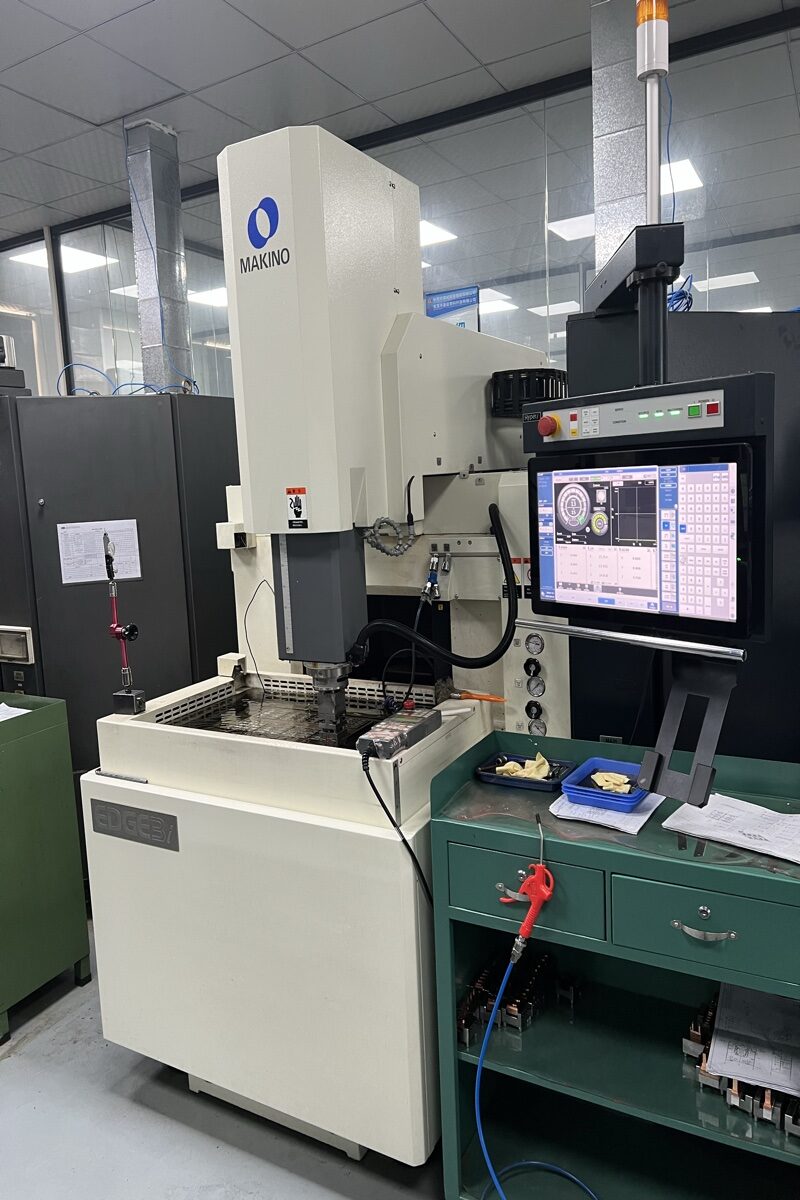
When is sinker EDM the right choice for a mold insert?
Sinker EDM is usually justified by one or more of these conditions:
- deep ribs, narrow slots or pockets that a cutter cannot reach without excessive deflection;
- internal forms, small radii or sharp corner detail that require a shaped electrode;
- hardened conductive tool steel where conventional finishing is impractical;
- complex local geometry that must be related accurately to other mold features;
- a specified EDM surface that will remain or be polished in a controlled later step.
EDM removes material by thermal electrical-discharge action rather than mechanical cutting force. That makes access and conductivity central to the decision. It does not remove the need for good fixturing, stable datums, flushing, thermal control or final inspection.
Sinker EDM, wire EDM, CNC or grinding: which process fits the feature?
| Process | Best-fit geometry | Main constraint | Typical planning question |
|---|---|---|---|
| CNC milling | Accessible faces, pockets and contours | Tool diameter, reach and deflection | Can a stable cutter reach the feature? |
| Sinker EDM | Blind internal forms, ribs and local detail | Electrode access, wear and flushing | How will the electrode and spark gap be controlled? |
| Wire EDM | Through profiles, punches, inserts and slots | Wire path and start-hole/access condition | Can the wire pass completely through? |
| Grinding | Flat, cylindrical and accessible precision surfaces | Wheel access and geometry | Is the final surface grindable after heat treatment? |
Many precision mold inserts use a coordinated route: CNC for bulk material removal, heat treatment where required, grinding for datum and fit surfaces, then sinker or wire EDM for the features that genuinely need it.
Why does the electrode strategy matter?
The electrode is part of the process definition. Its material, geometry, undersize, corner condition, number of duplicates and wear compensation influence the final cavity. A buyer does not need to prescribe every machine setting, but the supplier should be able to explain:
- whether separate roughing and finishing electrodes are planned;
- how spark gap or overburn is included in electrode geometry;
- which faces are affected by electrode wear;
- how deep or enclosed features will be flushed;
- how the electrode is located to the workpiece datums;
- whether spare electrodes are needed for repeat components or later mold maintenance.
One electrode may be adequate for a simple non-critical feature. A deep rib with demanding size and finish may require roughing and finishing electrodes, intermediate checks and a different wear strategy. The quote should reflect that difference.
What information should the drawing define for EDM?
A drawing should describe the required result, not merely say “EDM.” Identify the final geometry, datums, corner condition, surface requirement and any later polishing allowance. The guide to functional tolerance and datum planning shows how those relationships should be defined before a process is selected. ISO 1101 provides the symbol language and interpretation rules for geometrical tolerancing.[1] ISO 21920 covers current profile surface-texture specification concepts.[2]
For each EDM-critical feature, clarify:
- finished size or profile and its relationship to the datum system;
- minimum internal radius or corner expectation;
- draft, taper and depth;
- surface texture requirement and whether the EDM texture may remain;
- polishing, texturing or coating after EDM;
- edge requirements and areas where a sharp edge is functional;
- inspection method and report format.
Do not use a generic finish number to describe every wall and floor if different surfaces have different functions. A forming face, vent, shut-off and clearance surface may need different acceptance criteria.
How do flushing and depth affect EDM risk?
Stable debris removal is necessary for controlled discharge conditions. Deep, narrow or enclosed geometry makes flushing more difficult and can increase cycle time or variation. The supplier may need flushing holes, electrode motion, staged machining or modified parameters. These choices should be considered before electrode manufacture, particularly when a flushing provision would affect the component design.
Ask the supplier to identify features where depth-to-width ratio, trapped debris or poor access changes the assumed route. A “simple” thin rib repeated across a cavity may create more process risk than one larger pocket.
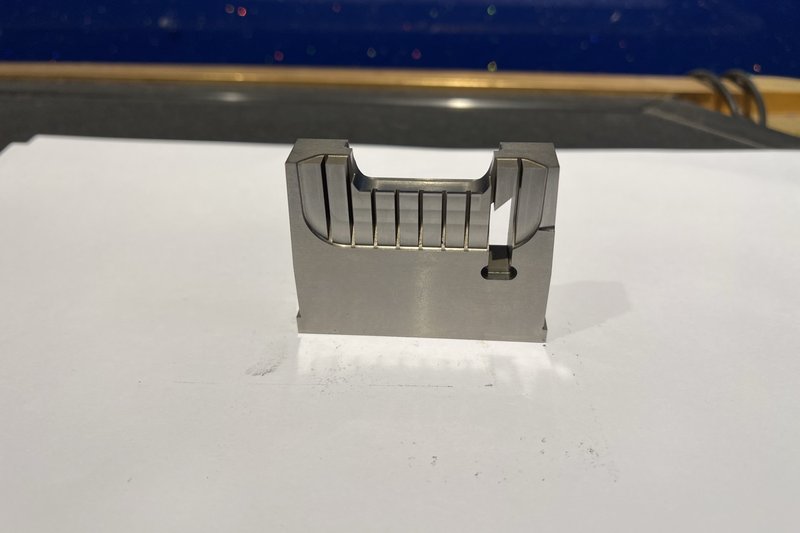
What about the EDM surface and recast layer?
EDM creates a thermally affected surface. The required finishing response depends on material, discharge energy, feature function and downstream polishing or coating. Roughing removes material faster but leaves a different surface condition from finishing. A responsible plan reserves finishing passes and, where the application requires it, additional polishing or surface treatment.
Do not turn a general surface-integrity concern into a universal specification. State the functional requirement: for example, a cosmetic molded surface to be polished, a high-cycle edge, a sliding shut-off or a fatigue-sensitive feature. Then agree on the process and evidence appropriate to that risk.
How should EDM features be inspected?
Inspection must use the same functional datum logic as the drawing. An EDM cavity can be internally consistent yet misplaced relative to a ground seating surface if machining and inspection coordinate systems are not linked.
NIST identifies machine geometry, probe behavior, software, thermal conditions and fixturing among contributors to CMM measurement uncertainty.[3] ISO 14253-1 addresses conformity decisions when measurement uncertainty matters near a specification limit.[4] For small internal features, also confirm whether a tactile probe can physically reach the surface and whether optical, replica, gauge or section-based evidence is more appropriate.
Seven questions to ask before approving an EDM quote
- Which features require sinker EDM, and why cannot they be machined more directly?
- Which features are better suited to wire EDM?
- How many roughing and finishing electrodes are planned?
- How are electrode wear, spark gap and corner geometry controlled?
- How will deep features be flushed?
- Which surfaces need later grinding, polishing, texturing or coating?
- How will the critical geometry be inspected from the drawing datums?
These questions belong in the controlled quotation package. The precision mold component RFQ guide explains the remaining material, revision, certification, delivery and acceptance inputs.
Frequently asked questions
Can EDM machine hardened tool steel?
Yes, provided the material is electrically conductive. Hardness is not the same type of cutting limitation it is for a conventional tool, but removal rate, surface condition, accuracy and the complete process route still need engineering review.
Can sinker EDM make a perfectly sharp internal corner?
No physical process creates a mathematically zero-radius corner. Electrode manufacturing, spark gap and wear produce a finite condition. Define the functional corner requirement instead of writing “sharp” without a measurable acceptance rule.
Is EDM always slower than milling?
Not in a useful project-level sense. For accessible bulk removal, milling is usually more direct. For an inaccessible hardened internal feature, EDM may avoid impractical tools, multiple operations or unstable cutting. Compare the complete route, not one machine’s removal rate.
Need a feature-by-feature process review? Send the drawing, 3D model, material, hardness and surface requirements through Huicheng’s contact page. We can identify which features belong in CNC, grinding, wire EDM or sinker EDM before confirming the route.